Review: Hungarian pianist Daniel Lebhardt at the Festival Drayton Centre
Hungarian pianist Daniel Lebhardt performed at the Festival Drayton Centre in Market Drayton on November 2, and John Hargreaves was there to review it.
Monumental drama and emotional turbulence ran through the entire programme of the opening concert in the Festival Centre’s classical music series. Pianist Daniel Lebhardt held nothing back in a virtuosic performance which was utterly thrilling.
Behind the power and hugely impressive technique of Lebhardt’s playing there were also moments of pathos and poetry. But even then, a stormy darkness threatened - however lightly Lebhardt’s fingers swept and pounced over the keyboard.
 This seemed literally the case in Beethoven’s sonata no. 17, known now as ‘The Tempest’. Written as the composer confronted the prospect of total deafness and briefly contemplated suicide, despair and rage seemed to dominate calmer moments in which perhaps hope persisted. The final, best known movement roiled with turmoil.
Lebhardt followed with a set of shorter pieces by his fellow Hungarian Franz Liszt. Composed towards the end of Liszt’s long life, ‘Unstern! Sinistre, disastro’ - translated as ‘Dark Star! Sinister, disastrous’ - was unremittingly bleak. Whether it was a reflection on the body’s eventual decline or the end of the world, it was as challenging to listen to as no doubt it was to play.
Mephisto Polka, sounding at first like a jolly folk tune, became progressively more threatening and weird. Csárdás macabre seemed like a fairground ride in a world of horror.
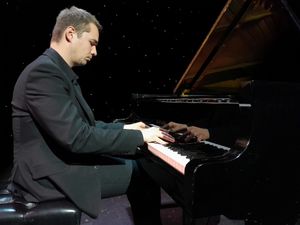
After the interval Lebhardt gave a deeply moving account of Funérailles, which Liszt wrote in the aftermath of the Hungarian uprising in 1848. A passionate, sometimes angry response to the crushing of a fragile independence movement by the mighty Austrian empire, Lebhardt’s heartfelt playing of it invited comparison with current events in Eastern Europe.
Finally, Chopin’s sonata no.3, from 1844. This was not Chopin the sweet romantic dreamer but something altogether more punchy and tempestuous. This sonata is less familiar than many other works by Chopin and that added to the sense of surprise.
The first movement grabbed attention then rolled onwards with poignancy and deep emotion. The third was more typically reflective but with no lessening of intensity. By the musically enormous final movement, one of the technically most challenging pieces in the piano repertoire, Lebhardt was playing like a force of nature.