Childhood dreams came true for Ruth
They closed an airport in Doha to allow us to display, exclaims Ruth Shackleton in wonder at the public's affection for her team. "An international airport!"
The RAF squadron leader has served in Iraq, Afghanistan, and a Libya that at the time was being ripped in two by war, and soared – if you'll pardon the pun – through each test.
But it's when she's talking about the public reception her new squadron has been afforded that she becomes most animated. It's hardly a surprise. She is the team manager for the Red Arrows after all.
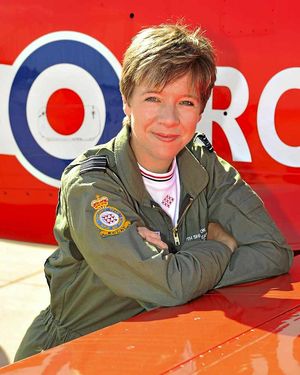
Now Squadron Leader Shackleton, who trained at RAF Shawbury and returns to the county on April 3 to speak at the inaugural Shropshire Star Excellence In Business Awards, at RAF Museum Cosford, takes charge of operations for the famous formation flyers.
"When I was a little girl I saw the Red Arrows and thought, wouldn't it be wonderful to be part of that?" she said.
Opportunity
"I never thought it would happen. I feel very privileged, this is a once in a lifetime opportunity, and particularly when you consider it's our 50th anniversary display season. There's no other job like mine.
"Until you're on the team you don't realise how significant it is. I have done the whole season now, and I am amazed at the love the general public has for us.
"People wonder up to me and introduce themselves and say 'hello Ruth', but I've never met them. People know who's on the team, and what they have done. The welcome is amazing.
"We toured the Middle East, passing 10 countries in 15 days, and the reception was amazing, such a highlight. Traffic stopped in the middle of Dubai and they closed the airport in Doha.
"I see school children who want to be the next Red Arrows pilot and aspire to be on the team, and I see OAPs who love it. It's ordinary working people through to VIPs. We have spent time with prime ministers, defence ministers, heads of state, and no matter what part of society people come from, the response is the same."
Squadron Leader Shackleton has been with the aerobatic aces for 16 months, providing ground support for the team.
Her place in charge of the 120-strong Red Arrows team marks a step change from her past experience working in some of the world's most hostile territories.
But she's not alone in seeing her career banking hard to the left to make the move into the world's most famous flying squad. "We are all from the air force and the pilots will be from our front line squadrons," she added. "We've all done tours of Afghanistan and Iraq. The pilots have got to be the best of everybody.
"I have done five operational deployments. Firstly in the Falklands, and I was sent to Iraq in 2003 with chinook helicopters. We followed the war through Kuwait and Iraq, all the way up until Basra. I lived in the field, in burnt out office buildings, a seriously hard time.
"Then I was sent to Afghanistan, to be an officer in charge of an airfield at Kandahar. I had to keep it open, but was dealing with rocket attacks, while running an airfield busier than Gatwick
"I was involved in Libya, ensuring that the Tornados had a base in Italy, and I was one of the people responsible for air transport back in Afghanistan, to the six big airfields.
"So yes, I have seen a lot of operational experience. What I'm doing now is no less exciting. I suppose you have to go through all those deployments to really appreciate what you're doing now."
Considering her role in keeping Britain's military planes and helicopters airborne, it is somewhat ironic that so much of the squadron leader's work has been performed from terra firma.
But she's in charge of the Red Arrows now. Surely he's had the chance to experience what must be the world's coolest joyride? Of course she has.
"The Hawks are fast jets for pilots to train on, so they have to be two seater, but we also use them because we can put photographers in the back.
"I have been up, and it's extraordinary. It simply takes your breath away. You can feel the G-force on your body from the manoeuvres being performed and the speed you are travelling.
"Straight and level flight is fine in an airliner, but to be able to manoeuvre at the speed they do, in such proximity to other aircraft..." she breathes out a sigh of awe. "You almost feel like you could stretch out and touch the next aircraft.
Squadron Leader Shackleton will bring a flavour of that precision flight to an audience of Shropshire's top business leaders next month.
"What businesses of the region and the Red Arrows team share is a constant striving to be the best,"
"It's about bringing teams together and people making a difference and doing amazing things.
"I sometimes feel bashful about it, but I get a lot of attention at events as people are very interested in hearing about the Red Arrows. I'm looking forward to meeting some really interesting people, and I hope my talk will be revealing."
Fact file:
The Red Arrows began training in 1964, and performed for the media for the first time on March 1, 1965. The first public display took place in France in May of the same year.
The team can fly in front of crowds as low as 300 feet, while its synchro pair can come as low as 100 feet lower than the height of Lord Hills Column in Shrewsbury.
Pilots can fly upside down, with the synchro team doing so as low as 150 feet above the ground.
The nine-strong team uses the most up-to-date trainer jets available.
Currently BAE Systems Hawk planes are used by the team. They shoot through the sky at speeds of more than 600 miles per hour.
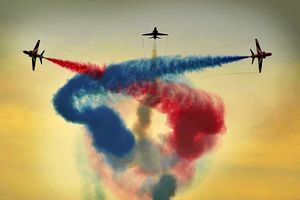
The coloured smoke produced during displays is actually vapour.
As well as looking spectacular it is coloured for safety as it allows the team leader to judge the wind speed and direction far more accurately than by any other means.
They also allow the team leader and synchro leader to keep sight of each other when two, and often three sections of the team are often several miles apart during the complicated aerial acrobatic displays.
* A handful of tickets remain for the Shropshire Star's Excellence In Business Awards. To guarantee your place at the evemt, call today on 01902 319360.
By Thom Kennedy