The long view: Author's newest work inspired by the Soulton Long Barrow
Slightly apart from the domestic life of Soulton Hall, standing in a space between the living fields and the ancient sky, is the Long Barrow. It is not the heart of the estate, but its witness—a liminal monument that keeps a quiet, watchful vigil over the land. This sense of "being apart" is the defining characteristic of Katharine E. Smith’s literary voice.
In Smith’s work, the Shropshire landscape is rarely a direct stage; instead, it is a presence that waits at the periphery. Much like the barrow itself, her narratives often occupy the spaces between—the transition from what was to what comes next. There is a specific tension in her writing that mirrors the barrow's location: it is close enough to be felt, but distant enough to provide a cold, clear perspective on human affairs.
Smith’s prose functions as a form of observation. Her characters move through their lives under the weight of this "apartness." This reflects the reality of the Soulton landscape, where the barrow doesn't demand attention, yet its silhouette subtly informs every horizon. In A Woman’s Work and her broader bibliography, there is a recurring theme of the "unseen observer"—the quiet realisation that our private histories are being recorded by the land we inhabit.
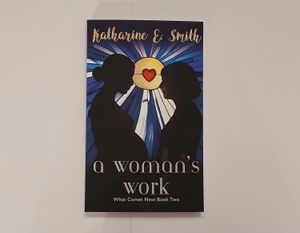
By placing the barrow at the threshold of her creative world, Smith captures the essence of the Shropshire borderlands. It is a place of crossing over. Her stories thrive in this atmosphere of stillness, where the modern world and the prehistoric silence of the barrow meet at a distance. She doesn't write from the centre of the noise; she writes from the quiet, watchful edge.