Sermons in stones… and good in everything - saintly discoveries at Soulton Hall
All observant Salopians will be familiar with the figure of ‘Old Sir Rowland’ on top of the stone column at Hawkstone Follies, overlooking the Soulton estate near Wem. More veteran readers, however, might also recall the avenue at Soulton which disappeared with Dutch Elm Disease in the 1970s. It is this lost avenue that leads to the site of a discovery that Shropshire may be home to one more saint than people realised.
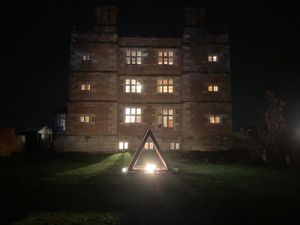
The year is 1556, and former Sheriff and Lord Mayor of London, Sir Rowland Hill, has taken over the Soulton Estate from Thomas Lodge, a friend and fellow elite merchant in the City of London. This saves Lodge from bankruptcy, and preserves centuries of Soulton’s tenure by Lord Mayors of London. Old Sir Rowland then adds a building to the old manor — the brick cube we know as Soulton Hall today.
But why?
Over the past few years, James D. Wenn (of Byrga Geniht) has looked at Soulton anew, uncovering its connection to a powerful history of geometry and symbolism in art. On Friday 21 April, 2023, we reported how James’ research links the mathematical design of Soulton to the King’s coronation, through clever nods to the medieval Coronation Pavement in Westminster Abbey.
"It was at this moment", James says, "I made another observation, and honestly started crying."
By reconstructing Soulton using its ‘twin’ house in Wales, Bachegraig, the building and its precinct bear an uncanny relationship with the look of the lost shrine that once held London’s patron saint, Saint Erkenwald (or Earconwald).
Old Sir Rowland was heavily associated with London’s civic identity, and the Middle English poem ‘Erkenwald’ tells the story of how back in the seventh century, St Erkenwald blessed and baptised an uncorrupted body of a kind of proto Lord Mayor unearthed during the building of St Paul’s Cathedral. This poem was written in a dialect local to Cheshire and North Shropshire, and its manuscript was actually found in Shropshire!
"Erkenwald in the poem is a sort of go-between. He saves the soul of a long-dead virtuous pagan statesman, providing a way for medieval people to reclaim their pre-Christian ancestors and passport-in Classical knowledge. This would underpin the Renaissance that Old Sir Rowland lived through in the 1400s and 1500s", James says.
Then suddenly, the observation was about more than intellectual symbols. The Ashton family had a photograph.
This photograph showed a parch mark — where dry weather browns grass unevenly — that revealed a square structure underground in the very middle of the precinct at Soulton Hall. Something had once been buried that the whole of Old Sir Rowland’s building work honoured… could it be the lost saint?
Biography took over, and Tim Ashton delved into written sources, revealing that Old Sir Rowland was either the Sheriff or the Mayor on both occasions that Henry VIII and Edward VI ordered the destruction of the saint’s shrine and the high altar of St Paul’s Cathedral.
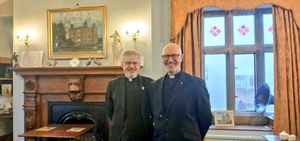
In April 2024, the Ashton family and Byrga Geniht put their work before a conference at Soulton including our local Anglican bishops. By the end of the year there had been ecumenical meetings in the House of Lords and City of London. After careful discussion and deliberation, everybody came to a firm conclusion.
"Essentially, even if we disturbed the peace of the site with archaeology, and found a box of bones with a name tag, and then subjected the remains to intrusive tests of radiocarbon dating and stable isotype analysis (the “when” and “where” of their origins)... it would still be a matter for faith whether a) the remains were Erkenwald, and b) whether Erkenwald was a holy man", says James,
"When the old St Paul’s Cathedral was obliterated by the Great Fire of London, nothing remained of the shrine, and no bones could be found anywhere that might be the Patron Saint. We are however very sure that Soulton Hall connects with the cultural memory of St Erkenwald, at a time when his shrine was disturbed by the Reformation."
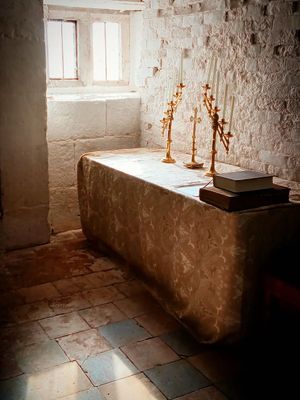
These truths led to a consensus, to make sure that Soulton Hall can be accessed by everybody as a moment in the memory of the Undivided Church (splits in Christian denominations postdate St Erkenwald’s life and ministry). This month, on 14 November (Erkenwald’s Day), there was an ecumenical service in the prayer room at Soulton led by Rev. Jukes of Wem, and attended by others including the Archdeacon of London, Luke Miller. Readings included lines from ‘Erkenwald’, and highlighted the joy of a connection with the historic depth of Christian fellowship across England.
What of the bones themselves? The site has now been secured against would-be disturbers of the ground. A large steel art sculpture, evoking the lost pyramid roof of Soulton Hall, is temporarily anchored over the parch mark in the precinct. In time, plans agreed in the House of Lords meetings indicate that a paved monument with a bronze tablet remembering Erkenwald may maintain the peace and dignity of the spot… as well as locking-in the mystery. As these works advance, the space can welcome more people as well as cultural events such as Harry Frost’s epic live reading of ‘Erkenwald’ at Soulton earlier in the year.
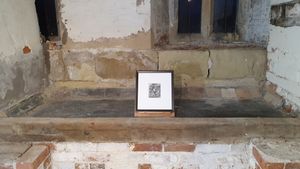
"It has been a real pilgrimage, from beginning to read the buildings at Soulton Hall, to understanding what the bricks and stones are saying, a rich and often poignant story of cultural preservation through time emerges. The best way we can honour this legacy is by drawing attention to all its rich connections, and celebrating them through art that has connected us and continues to do so. The myths, legends and mysteries around Erkenwald are a powerful part of our culture that can be seen and experienced in North Shropshire as well as the City of London."