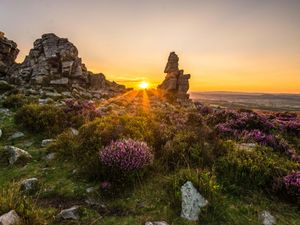
More than 1,000 hectares of rare Shropshire uplands protected as part of expanded Stiperstones nature reserve
More than a thousand hectares of rare uplands in the Shropshire Hills have been secured for wildlife, as a nature reserve expands to triple its original size.
The new Stiperstones Landscape national nature reserve will conserve 1,562 hectares (3,900 acres) of heathland, ancient woodland, bogs and acidic grasslands linked by unique geology, safeguarding an area more than three times the size of the original Stiperstones reserve.
Government agency Natural England said the new reserve combined existing protected sites with more than 1,100 hectares of additional land managed by partner organisations to link up habitats and protect rare plants and threatened wildlife such as the bilberry bumblebee.
It will capture carbon, manage flood risk and improve water quality, and preserve ancient quartzite tors, where Wild Edric and his fairy queen Godda of Saxon legend are said to still gallop whenever England faces peril, Natural England said.
The new reserve forms part of the “King’s Series of National Nature Reserves”, created to mark Charles’s lifelong support for the natural environment, with 25 new protected areas planned by 2028.
Tony Juniper, chairman of Natural England, said: “Enhancing and expanding our nature-rich landscapes is one of the most critical actions we must take to achieve our stretching environmental targets; this landmark moment for nature recovery is the next step on that path.
“Collaboration across this landscape will protect the upland heath and ancient woodland conserving rare species while also creating more opportunities for local people to experience the joy of nature first hand.”
Forestry England, The Linley Estate, Shropshire Council, Shropshire Wildlife Trust, Middle Marches Community Land Trust and Natural England have joined forces to deliver the new reserve.
Dr Richard Keymer, Middle Marches Community Land Trust chairman, said: “Middle Marches Community Land Trust is delighted that the Stiperstones National Nature Reserve is to be extended and will include two areas of land that we own, Minsterley Meadows and Norbury Hill.
“Larger areas of land managed for nature will make them more resilient in the face of a changing climate,” he said.
The Stiperstones are visited by hundreds of thousands of people every year, all attracted by its wild beauty. They are an important part of the offering to tourists who come to the county for holidays and day trips. They are also popular with photographers and artists, who love its ruggedness and huge horizons.
An England cricketing legend with a love of painting recently spoke of his love for the Shropshire landmark.
Jack Russell MBE is well-known for his immense skills behind the stumps as a wicket keeper, and represented England in more than 50 test matches and 40 one-day international games.
But the 61-year-old is now known for his abilities as an artist and recently revealed his new painting "Mist and Show, Stiperstones" which was created at the top of the Stiperstones.
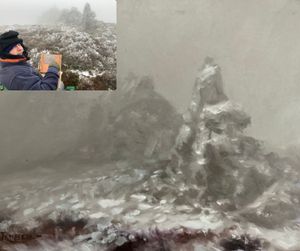
The cricketing legend, who lives in Gloucestershire, said he tries to paint in the county as often as he can, and has spent hours at the top of the distinctive hill - with as many layers on as possible to keep warm - and a paintbrush in hand.
He said: "I discovered the hidden gem that is Shropshire when I was playing cricket for Gloucestershire. We played a NatWest Trophy match there. It was rained off for two days so I spent that time exploring the county so have always had a fondness for it ever since.”
The Stiperstones are famous for exposed cliff faces, known as dramatic exposures. They include The Devils Chair and Cranberry Rock. These are made of a rock known as Stiperstones Quartzite. It is an important landmark in Shropshire and has had a role in the industrial development of the area due to its geology as lead has been mined here since Roman times.