Memorable year for farmers
To everyone connected with Shropshire's farming industry, 2007 has been a freak year - definitely one to file away under "annus horribilis", writes Rural Affairs Editor Nathan Rous.
 To everyone connected with Shropshire's farming industry, 2007 has been a freak year - definitely one to file away under "annus horribilis", writes Rural Affairs Editor Nathan Rous.
Yet it hasn't all been doom and gloom. Hundreds of people from across the county showed their passionate support in the Great Milk Debate in April and, since then, dairy farmers have begun to see a proper return on their product.
Now a similar campaign is working up a head of steam in support of our livestock sector, which has been crippled by rising costs and plummeting prices.
We asked two of the most influential farmers in Shropshire to give us their views on what has been the toughest of years.
For Shropshire NFU chairman Adrian Joynt and his predecessor John Brown, there have been dark times. But resilience shines through to give us all hope for 2008. Here are their thoughts:
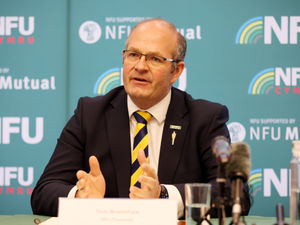
Adrian Joynt:
 I recall writing a magazine article at the start of my term as NFU county chairman, about the fact that every chairman seems to have a major issue occur during their time in office.
My first year has certainly been no exception, with flooding, foot and mouth, bluetongue disease and avian influenza to name but a few.
The fortunes of agriculture have always been influenced by the weather. This year has shown just how global the food market has become, with the April drought and summer floods in the UK, coupled with drought in Australia and parts of Europe contributing to a poor harvest worldwide.
This and the fact that for the last seven years the world has consumed more grain than it has produced, has meant that world stocks of grain have all but disappeared, causing the farmgate price of grain to double in the last year.
In the dairy sector, no-one could have predicted how the milk price has increased, low production in the UK due to weather and a decreasing number of dairy farmers, along with increasing demand for dairy products in India and China, has led to the rapid price increase. This is a far cry from the reasons behind the Great Milk Debate that was held in April by the WI, to highlight the plight of the dairy industry.
The downside of the high grain prices is increased food prices for the livestock sector, and this is an area of concern for all.
With the export market for meat now reopened, and a decreasing supply of meat in some sectors, the prospects for the future look encouraging.
Foot and mouth was something nobody wanted to see again, and it could not have come at worse time for the sheep industry; stopping meat exports at their peak. With the cost of foot and mouth to the rural economy estimated at more than £100 million and the cost to Defra approaching £50 million (their estimate), surely the petty penny-pinching over the cost of repairing a leaking drain seems a false economy.
The outbreaks of bluetongue and avian influenza did not come as a surprise. As airborne viruses, it was always going to be difficult to keep them out of this country.
In the UK we have an advantage over our European counterparts in that we should be able to learn from their experiences with bluetongue and be better prepared for it next summer.
An efficient vaccine will be the key and it will need to be available by spring 2008. With Defra keen to push the cost of disease control onto the industry, it will be interesting to see what strategy they adopt.
Bovine TB remains as prevalent as ever, and it is increasingly obvious that the current system of cattle-based controls is not working. The Government's own scientists agree that the wildlife reservoir plays a significant part in the transmission of the disease to cattle, they just can not agree on what to do about it!
As for 2008, I am sure that the public's increasing awareness of how and where food is produced, the growing demand for better quality food worldwide and the rapid rise in the use of biofuels and renewable energy sources will lead to more prosperous times for British agriculture.
I sense that agriculture will be an industry of opportunities in the next few years, for those who want to take them.
John Brown:
 Coming to the turn of the year, farmers often take stock of the previous 12 months.
To many, the farming new year has already started, with the drilling of cereals for next year's harvest, while stock farmers are settled into their winter work routine.
If a few minutes can be spared to ponder "has 2007 been a year to remember?", the answer is unquestionalably "yes".
The weather has been memorable. Farming is so dependent on rain or sun. The spring was dry, which was fine to turn the cows out, but the grass disappeared in the drought.
Then the rain started. Who can forget June and July? We twice had the cows flooded off the pasture and our arable crops suffered waterlogging. For 80 days from mid-May to late July we had an average quarter-inch of rain a day.
Then it stopped and much of the damage of the summer was repaired by a beautiful autumn.
It was also the year that the world really came to the boil for consumers and farmers.
The stupidest statement of the year came from the chairman of the British Retail Consortium. When asked "will the summer floods and the trouble it caused agriculture increase food prices?", he said: "no, we can always import from abroad". But he can't, because the Chinese and the Indians have hard currency and want it as well.
For most of the previous 10 years the world has used more cereals than it has produced and we have to grow more or the cupboard will be bare. The world also uses more dairy products than it produces.
The Government and supermarkets must treat us differently. We are ready to supply at good cost with more than a passing eye to animal welfare and the environment, but not at below the cost of production.
World shortages and bad weather have increased my milk price by 40 per cent lately but I still receive less than I did 10 years ago.
I was pleased this spring to see the WI campaign for a better milk price with the Great Milk Debate and now we have the Townswomen's Guild doing the same for beef and sheep. Times are changing and it is good to see allies helping us sell both farming and our products to the public.