‘Far too many children due to start school without protection against serious diseases’ - Shropshire health leaders warn
Health leaders in Shropshire say there is ‘more to do’ as new figures reveal the number of children who remain unvaccinated against serious illnesses just days before the new school term starts.
Nationally almost one in five (20 per cent) of children starting primary school are not fully protected against diseases including measles, mumps and rubella, polio, whooping cough, tetanus and diphtheria.
Vaccination rates have actually recently risen in Shropshire and Telford & Wrekin. But there still remain a significant number of children who are not protected by the jabs, according to data published by the UK Health Security Agency and complied by the Press Association.
The UKHSA and NHS England are asking parents to check their child’s vaccine records and catch up on any missed vaccinations with their GP.
Rachel Robinson, the executive director for Public Health on behalf of NHS Shropshire, Telford and Wrekin, said local teams have been working hard to improve vaccination rates.
“We’re pleased to see vaccination rates rising in Shropshire, Telford and Wrekin,” said the public health chief.
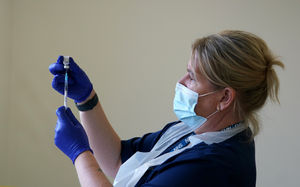
“This reflects the hard work of NHS teams and partners making vaccines more accessible through flexible clinic times, school-aged immunisation services, pop-up sessions in community settings, targeted outreach with trusted community leaders, and supporting families with clear, trusted information.”
She added that vaccine reminders are sent directly to parents and awareness sessions are held in education and community settings, “helping families to make informed decisions.”
MMR vaccination confidence had been dented by long since discredited ‘research’ and the Shropshire health chiefs say while confidence is improving they have more to do.
“While confidence in MMR is improving, we know there’s more to do and will continue focusing on reaching every child, especially in communities that are harder to access, helping to reduce barriers whether that’s through mobile clinics, translation and interpreting services, or one-to-one support for families who may be hesitant,” said Rachel Robinson.
“Vaccines remain one of the most effective and evidence-based ways to keep children healthy, and we will continue working with partners and local communities to ensure as many children as possible are fully protected.”
Dr Mary Ramsay, Director of Immunisation at UK Health Security Agency, said: “Far too many children will not be fully protected and safe when starting school and are at risk of serious diseases, such as measles and whooping cough, that have in recent years caused outbreaks.
“Measles, being the most infectious disease, is the ‘canary in the coalmine’ and a wake-up call that urgent action is needed to stop the very real risk of other diseases re-emerging.”
Health Minister Stephen Kinnock said: “Too many children are starting primary school without complete protection against preventable and potentially serious illnesses like measles, whooping cough and mumps.
“We know parents want to do right by their children and we’re working with the NHS to make it easier for all families to access these life-saving vaccines.”
From January another vaccination will offered for the first time time to children across England. The Government has announced that a free chickenpox vaccination which it says will protect around half a million children each year.
PA has compiled a list of childhood vaccination uptakes across the country, including in Shropshire, Telford & Wrekin.
MMR vaccine (measles, mumps & rubella), both doses at age five:
Cumbria is at the top with 94.3 per cent having dropped back from a previous rate of 94.8 per cent.
Shropshire at 90.3 per cent and Telford & Wrekin 87.9 per cent have both shown increased uptake of a couple of percentage points.
They remain well above Kensington & Chelsea in London where the vaccinate rate has fall some eight per cent to 56.3 per cent.
The four-in-one booster (polio, whooping cough, tetanus & diphtheria) at age five.
Top placed Cumbria at 94.3 per cent has dropped from 94.4 per cent.
Shropshire’s rate has increased from 88.7 per cent to 89.3 per cent while in Telford and Wrekin the rate has risen from 84.8 per cent to 86.4 per cent.
Shropshire is well ahead of lowest placed Kensington & Chelsea on 44 per cent.
The six in one vaccine against diphtheria, pertussis, tetanus, polio Haemophilus influenzae type B, and hepatitis B
Both Shropshire and Telford & Wrekin show rates increasing above 95 per cent. This compared to top-placed East Riding of Yorkshire at 97.6 per cent and the lowest placed Hackney at 74.4 per cent.
In England over the last 10 years, the coverage or uptake rates for the pre-school booster peaked at 86.3 per cent in 2015 to 2016.
The latest data, at 81.4 per cent, is nearly 5 per cent lower than the peak. Outside of London, the coverage for England was 85 per cent.