Challenge for farming
Farmers and rural businesses in Shropshire and Mid Wales are facing another year of challenge and unrest, the NatWest has revealed.
 Farmers and rural businesses in Shropshire and Mid Wales are facing another year of challenge and unrest, the NatWest has revealed.
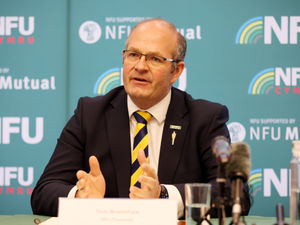
The prediction comes from Martin Doyle, NatWest and RBS director of agriculture, Wales and borders, who said the market divide between arable and livestock sectors would continue.
He also believed the stiffening of nitrate controls would create additional financial burden, while an overall economic slowdown would hit every industry.
"The changes in the Common Agricultural Policy in recent years have exposed farmers to increased market volatility and therefore risk," Mr Doyle said.
"Farmers adopt a range of strategies to deal with risk, including their choice of enterprises or by forward contracting some of their production. Price and yield volatility are likely to continue in all sectors in the future – it is only the degree of volatility which is in question.
In the arable sector, the futures markets suggest that prices will fall back from this year's peak, to around £130 per tonne. This is still well ahead of recent years, despite the increase in production which is anticipated, as a result of land being taken out of setaside. It remains important for arable farmers to protect their margins by controlling costs and continuing to manage risks.
"In the dairy sector, forecasts for world prices also remain firm. As a result, profitability should continue to improve – despite rising costs. This will be welcomed in a sector which has endured a prolonged period of financial pressure and could provide the foundation for reinvestment.
"Against this background, the introduction of nitrate controls in the Nitrate Vulnerable Zones, will create an additional financial burden – particularly in the pig and dairy sectors where many units will have to invest in additional slurry storage."
Despite the uncertainties in the sector, there has been no slowdown in the demand for land. The acreage marketed in 2007 has been very similar to the previous year.
Average values in the past year have increased by around 30 per cent. The best arable land is topping £5,000 pa, with the average for prime arable land just under £4,000.
Mr Doyle continued: "Although it is unclear what impact the proposed changes in Capital Gains Tax will have on the land market in the longer term, there is no evidence to suggest there will be a marked change in the supply and demand position in 2008.
"We can see increasing evidence of farms diversifying their businesses and examining how best to utilise all their assets. This is not simply restricted to their physical assets of land, buildings or machinery. It is also includes their own skills and those of their workforce.
"While 2008 will bring its own challenges, particularly for the livestock sector, we should not lose sight of how quickly things can change. The future will be challenging – but we should be encouraged by the increasing demands we are beginning to see for the products derived from agriculture."