Presteigne rural arts charity awarded £244.8k National Lottery Heritage Funding to develop a masterplan for their historic sites
Rural arts charity the Sidney Nolan Trust is delighted to announce a £244,849 grant from The National Lottery Heritage Fund to develop a masterplan for a vibrant and resilient future
Rural arts charity the Sidney Nolan Trust is delighted to announce a £244,849 grant from The National Lottery Heritage Fund to develop a masterplan for a vibrant and resilient future.
This transformational funding will enable strategic planning, audience consultation, building surveys and pilot activities delivered over the next 12 months.
Together these will feed into a masterplan shaped to increase access and audience engagement and realise the potential of the historic, environmental and cultural significance of the Trust’s two sites.
The project will encompass both the charity’s heritage locations in the Welsh Marches: The Rodd, near Presteigne, in North Herefordshire and the Bleddfa Centre, near Knighton, in Powys.
These unique sites are linked to centuries of local rural identity and heritage. They connect the England-Wales Borders to the world through art and agricultural histories, preserve and provide access to important and varied natural habitats and deliver engagement and participation opportunities in some of the most rural wards of England and Wales.
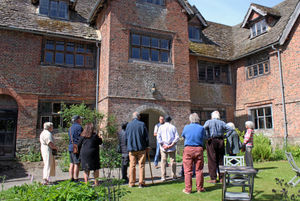
The Rodd is a 400+ year old estate and working farm in the Hindwell river valley spanning 180 acres of farmland, woodland, river frontage and gardens. In the 19th century it was a centre for the breeding of Hereford Cattle, establishing bloodlines that travelled as far as America and Australia.
At its heart is Grade II* listed Jacobean Rodd Court and several 18th century timber-framed barn structures including the Grade II-listed West Barn.
The house is very little-altered with significant and important examples of brickwork and woodwork in a rural Herefordshire context.
Rodd Court has been lived in by artists for over a century. In 1983 it became the final home of leading Australian artist Sir Sidney Nolan CBE RA (1917-1992) who founded the Trust in his name as a rural centre for the arts in 1985.
The Trust looks after and makes accessible the largest collection of his artwork outside of Australia, extensive personal archive and library. Visitors can see Nolan’s only surviving studio, preserved intact since his death.
The Bleddfa Centre was founded in 1974 in the remote village of Bleddfa by pioneering theatre director James Roose Evans.
Adjacent to the 13th century St Mary Magdalene’s Church, it comprises much-needed community art, social and event spaces across the former village schoolhouse and converted Hall Barn.
The placename Bleddfa, ‘the abode of wolves’ in Welsh, reflects the wild history of the surrounding Radnor Forest and the community’s connection to its environment.
This vital support from the Heritage Fund enables the Sidney Nolan Trust to bring in the resources and diverse expertise needed to plan strategically and sensitively to secure the future of these sites.
Without undertaking this work now there is a significant risk to the longterm caretaking of this complex and large-scale heritage and landscape.
This funding also protects and enhances the increased access and participation of regional audiences, addressing an acute need.
The communities of North Herefordshire and Radnorshire in Powys are amongst the 50% most deprived in the UK, and face some of the worst indices nationally of geographical deprivation – through lack of access to services.
Through the project the important built heritage and landscape the Trust looks after will be better protected and made more accessible through a wide range of expert building/land surveys, a feasibility report, and architectural visualisations.
Prioritised and costed plans for repair, restoration and potential future use will enable maintenance and business planning and build the case for future investment and fundraising.
Staff and volunteers will receive training in species identification and surveys. The monitoring of flora and fauna will establish baseline understanding and priorities for the future ecological management and improvement of the charity’s varied habitats.
Expert drainage surveys will address site water management to mitigate both flooding risks and phosphate impacts.
Volunteering opportunities and an oral history project capturing a range of living history connected to The Rodd and Bleddfa will directly involve wider audiences, voices and experiences of heritage.
Extensive audience research and consultation will increase community and stakeholder involvement. This will enable the Trust to shape future development and programmes in line with local and regional need, and to broaden participation.
Crucially this support from the Heritage Fund will enable a thoroughly researched options appraisal for future increased use of site and spaces, a strategic business plan, and income generation and fundraising strategy.
Together these will lay a firm foundation for the next step on the journey - enabling the Trust to seek future fundraising and investment for resilient and sustainable capital regeneration works.
There will be events and activities taking place throughout the project at The Rodd, the Bleddfa Centre and online – keep an eye on the SNT What’s On page www.sidneynolantrust.org/your- visit/whats-on/ .
You can also sign up to e-news to stay in touch with the latest news and progress and follow SNT on facebook and Instagram @sidneynolantrust.
The Trust is looking for volunteers across a wide range of activities to get involved and support the project delivery. To express interest or find out more please email info@sidneynolantrust.org.
Sophie Heath, Director of the Sidney Nolan Trust, said: “It is wonderful to have received this hugely valued support from The National Lottery Heritage Fund. Thanks to National Lottery players we can take on the challenge of establishing an inclusive, thriving future for our unique places that provide access to inspiring heritage, nature and creativity in our rural region.”