International Women's Day: How Megan pedalled back from the brink
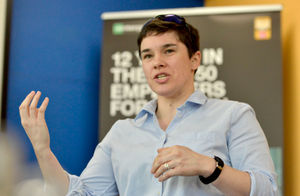
Paralympian gold cycling medallist Megan Giglia spoke in Shrewsbury to mark International Women’s Day.
She told staff at Enterprise Flex-E-Rent how a life-changing ordeal had made her appreciate every day and want to make the most of every opportunity.
Megan recalled walking sheepishly up to the reception desk at the A&E unit in Manchester, having fainted at work.
“I felt like a bit of a hypochondriac,” she recalls. “There were all these people with bloody noses and broken arms who were sitting around waiting to be seen. I went up the desk and said ‘I’m not sure if I should be here’.”
She had actually suffered a stroke and a brain haemorrhage that would change her life forever, sending her into a spiral of depression – before being inspired by friend’s terminally ill mother to turn her life around and enjoy a career as an international athlete.
In January 2013 Megan walked into A&E, having also suffered with severe headaches, a bloodshot eye and stiff neck. Tests eventually revealed blood in her spinal fluids caused by bleeding from the brain.
“This guy in a suit and tie, very smart and very handsome came up to me, I remember I had never seen him before, and said to me ‘you have a Subarachnoid brain haemorrhage, and showed me lots of pictures.”
Megan, who had worked as a fitness instructor, PE teacher and police officer before her illness, was sent to a hospital in Birmingham for an operation.
“They said I would be out in about three days, and walking,” she remembers.
Complications caused during the surgery meant she would actually spend two weeks in an induced coma. She woke up to find she had lost function on the right side of her body and had a tube down her throat to stop her lungs collapsing.
“I heard people talking about me, they were saying I couldn’t speak, and I thought ‘take the tube out and I’ll show you I can speak,” she says.
“But when they did that, I couldn’t speak. All my words were jumbled up, in my head they made perfect sense, but nobody had any idea what I was saying.”
See also:
Despite also suffering with epilepsy and swallowing problems as a result of the stroke, the 27-year-old made rapid progress in a rehabilitation ward, quickly learning to walk and speak once more. Confident she could look after herself she discharged herself from hospital – and it was only then that the severity of her condition became apparent.
“In hospital I was the strongest there, all the other people were a lot older than me, but when I got home I noticed how people would look at me,” she says.
“I was having to use my hand and mouth to tie a shoelace. I couldn’t get into the bath properly. I had to climb in like a worm.”
Wallowing
Feeling sorry for herself, she went to see a friend, and took up residence in her living room.
“I spent the next three weeks on her sofa, wallowing in self-pity, and my friend was putting up with me. Every day, she went to work and returned home to my ugly mug.
“One day, her mum came over. She was called Karen Wardell and she took me out for a coffee. She then went through all the opportunities that we get in life, she said ‘you were a fantastic sports person before the stroke, why can’t you do it again?’”
“Karen had terminal cancer when she told me this and she died just three months after we had the talk.
“She knew she didn’t have a lot of time ahead of her, but she managed.
“I had a lifetime ahead of me. It would be different, but it made me have a lot more respect for other people and myself.”
After trying various sports Megan took up cycling in 2014, using a custom-made splint to support her weak right leg. She was selected for the Great Britain team at the 2015 UCI Para-cycling Track World Championships at Apeldoorn in the Netherlands, finishing just outside the medal positions.
Her big breakthrough came at the 2016 World Championships at Montichiari in Italy, where she took gold in both the 500m time-trial and the individual pursuit, setting new records in both events.
She followed up this success at the 2016 Paralympics in Rio, winning the women’s 3,000m individual pursuit, Britain’s first medal of the games.
The crowning glory came in the 2017 New Year Honours list when she was appointed an MBE.
Her condition has left her with fluctuating mobility on the right side of her body, but she says she has learned to cope with the bad days she inevitably suffers.
“We all have our off days, that might be down to something as simple as scraping the car or leaving your phone at home,” she says.
“The thing is, you just accept there will be bad days, you get through them and you put them behind you and start again the next day.
“It’s not about what happened to me, but what I choose to become.”