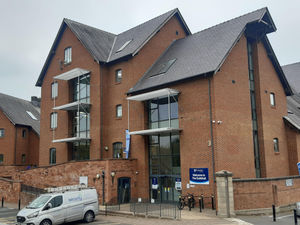
Plan to close Shrewsbury Magistrates Court under fire
The closure of Shrewsbury Magistrates Court will make the delivery of justice in the community "impossible", a Shropshire solicitor has said.
Shrewsbury Magistrates Court will close within five months and cases will be heard at Telford following the closure.
Chris Grainger, a solicitor at Lanyon Bowdler who represents defendants across the county, said: "For those without a car getting to Shrewsbury and back again is a significant cost, and closing Shrewsbury Magistrates Court is going to exacerbate that problem, especially for those travelling from Oswestry and Market Drayton.
"Closing magistrates courts also has a huge impact on defendants when they are in court because it makes it very difficult for their family to attend hearings to support them.
"An important principle of law is that justice should be seen to be done within the community where the crime has taken place, and closing courts like this is making that impossible."
Malcolm Richardson, chairman of the Magistrates Association, said: "There will be inevitable additional pressure on the system and the paramount concern of magistrates is for accessible justice to be protected. We hope the Ministry of Justice will work closely with magistrates to safeguard it."
The move will also see Shrewsbury Crown Court moved from its current base at Shirehall into the vacated magistrates' premises nearby in Preston Street.
The decision has been taken by the Ministry of Justice following consultation launched in July last year. It means that people will be required to travel from north of Oswestry and from the south Shropshire border to Telford for hearings.
No timescale has yet been put forward for the crown court's move, although Shrewsbury Magistrates Court will close some time between now and June.
The Shropshire branch of the Magistrates Association had objected to the closure on the basis that it would restrict access to justice by making it "difficult or impossible" for some people to get to Telford by 9.30am.
In its response the Ministry of Justice said it accepted that some people would face increased travel times but added: "In line with current practice, court and tribunal users who face exceptional difficulties in attending court for a particular time can make an application to have their case heard at a different time on an individual basis."
The closure of Shrewsbury Magistrates Court will leave Shropshire with just one magistrates court, in Telford.
It is a far cry from the picture 40 years ago where nearly every town in the county would convene its own magistrates' court once a week. The bench, made up of local magistrates, would set up and dispense local justice to people accused of committing crimes in their locality.
Slowly, more than 15 courts have disappeared, with Church Stretton, Oswestry, Bishop's Castle, Market Drayton, Ludlow, Cleobury Mortimer, Ironbridge, Madeley, Woodside, Much Wenlock, Shifnal, Wem, Whitchurch, Ellesmere, Shrewsbury, and Bridgnorth, all being chipped away until only one remains.
Judith Clayton, of Alkington near Whitchurch, sat on the Market Drayton bench for more than 20 years. She said the importance of local justice has been forgotten. She said: "I was chairman of the local magistrates here in north Shropshire when they closed Market Drayton and Wem courts. I resisted very strongly at the time because I felt local justice in a rural county has to be done locally.
"When I was first appointed in the early 1980s . . . local justice was very much seen to be done locally. It involved the local population and that something that people do not appreciate."
John McMillan, of WMB Law, who has practised criminal law in Shropshire's courts for more than 40 years, said he believes the loss of local justice has been a "retrograde step".
He said: "We used to have about 15 courts and the advantage of those was that they were local courts for local justice. They had their own magistrates who were local JPs who knew what the problems were, what was going on in their local town, and the advantage was they were able to deal with local problems.
"Now I expect a bench of magistrates sitting at Telford would not know where Bishop's Castle is, let alone the problems somewhere like Cleobury Mortimer. It is light years away. I think there is no doubt it is a retrograde step."