From Brookside to Big Brother: 30 years of Channel 4
Today marks 30 years since the launch of TV network Channel 4. Mark Andrews & Carl Jones look back at the highs and lows of the past three decades.
An orchestral fanfare, followed by the announcement: "Good afternoon. It's a pleasure to be able to say to you: Welcome to Channel 4."
It's remarkable how 30 years on, this simple introduction delivered in Paul Coia's smooth Edinburgh brogue, still sticks in the mind.
But given that there had been talk of a fourth television channel since the mid-1950s, it is not that surprising that the launch of Channel 4 was surrounded with much excitement.
At 4.45pm on Tuesday, November 2, 1982 millions tuned in to watch broadcast history being made.
A four-minute trailer, set to a full-length version of David Dundas' classic Fourscore signature tune, promised a world of wildlife programmes, grand opera and costume drama, with a wrestling bout crowbarred incongruously in between.
However, what the first viewers actually got was a remake of a regional quiz show . . . and a lot of swearing.
Perhaps it was always going to be difficult for the new station to live up to the hype that had built up over the previous weeks. Nevertheless, Channel 4 got off to a shaky start, to say the least.
The first programme to be aired was Countdown, a revamped version of Yorkshire Television's Calendar Countdown, fronted by Richard Whiteley and Ted Moult. For a channel whose remit was to be fresh, innovative and thought-provoking, many wondered why it had been launched with a quiz show.

Brookside, the station's flagship soap opera, billed as a rival to Crossroads, Coronation Street and even Dallas (!), was also met with a lukewarm response, and a string of complaints about its foul language.
The first episode about loveable – and not-so-loveable Scousers – attracted a reasonable 4.2 million viewers, though and the series eventually made stars of Ricky Tomlinson, Sue Johnston and Anna Friel before having its plug pulled in 1993.
Not everyone, of course, was able to watch the new station in those days. Some viewers in Shropshire could only get Channel 4 when it rained – and the transmission quality was always poor compared to BBC and ITV.
The station quickly picked up the nickname Channel Bore. "The tabloids had a field day," recalls its first chief executive Jeremy Isaacs.
The launch was accompanied by three separate protests. While viewers and critics complained about its niche rather than mass-market output, deaf campaigners and animal rights activists still turned out to picket the studios, saying they weren't being given a voice.
But it was the third group of protesters which presented the biggest headache. A dispute over payments to actors in advertisements meant the new station was unable to screen commercials featuring members of the acting union Equity, which saw many gaps in schedules filled by instrumental interludes.
Indeed, so precarious did the station's opening week look, that many pundits were immediately predicting its demise.
On the day of its launch, some commentators were predicting it would be reduced to four or five hours a night of strictly specialist viewing, subsidised by commercial sponsorship.
So how is it still with us, 30 years on? Well, while it failed to capture the mass audiences of its rivals, there was plenty of variety – and several notable successes.
Shropshire TV and radio presenter Sybil Ruscoe was at the heart of one of them.
She recalls: "The summer of 1999 was my glorious C4 moment when I was picked for the C4 Cricket team alongside Richie Benaud and Mark Nicholas. C4 Cricket was on a mission to take the national summer game to the masses and to enthuse a new generation about the joy of off-spin and cover drives.
"Growing up watching my dad play on the cricket fields of Shropshire at the Castle Fields in Wem and at Rubery Owen in Prees, this was a dream job and I spent four years working at places like Lord's, Edgbaston and New Road interviewing Tendulkar, Warne, Waugh, Donald and Atherton. C4 Cricket was extremely popular and we won awards from BAFTA and the Royal Television Society."
Elsewhere on the Channel 4 schedule, repeats of 1960s American shows such as I Love Lucy and The Munsters may not have been cutting edge, but they were inexpensive and had a certain nostalgic appeal. Old episodes of Upstairs, Downstairs and Man About The House (whatever happened to Richard O'Sullivan?) also guaranteed a steady audience.
The new channel's Friday teatime music show The Tube (along with Jools Holland's infamous 'groovy' call) became an influential springboard to many up-and-coming acts and hit the ground running with The Jam featuring live on its very first show on 1982.
At the time, that was akin to having The Beatles on board and the show, filmed in Newcastle, became the stuff of legend among 1980s teenagers fed up with the Beeb's increasingly naff Top of the Pops.
The station continued to attract controversy. In the early 1990s its youth-orientated Friday night show The Word seemed to go out of its way to offend, but the outrage only seemed to boost ratings – and mad Mancunian presenter Terry Christian's ego.
TFI Friday (geddit kids?) a Friday evening magazine programme fronted by Chris Evans, did not push the boundaries quite so far, but it still ruffled a few feathers particularly when Happy Mondays star Shaun Ryder developed f-word tourettes as a nation sat down to tea. After that it was pre-recorded by 10 minutes to edit out any future swearing.
Some of the more off-the-wall ideas from the early days – such as Cut Price Comedy Show, which celebrated the bad joke, and People's Court, which began with a dispute over a bald tyre – fell by the wayside, but the station also launched the careers of Jonathan Ross and Graham Norton.
Whether that's a good or bad thing – you decide . . .
It also brought us award-winning satire in the shape of Alan Bleasdale's political thriller GBH (who can forget Robert Lindsay's award-winning turn as Michael Murray?) and the newsroom sitcom Drop The Dead Donkey, which broke the mould by filming on the day of broadcast to make sure it was up-to-date.
But probably the programme that would define Channel 4 more than any other came 18 years after the launch. In 2000 Channel 4 commissioned Dutch company Endemol to produce a UK version of its ground-breaking reality show Big Brother, where a group of disparate people lived together in a house for nine weeks, and viewers voted by phone to evict one contestant each week.
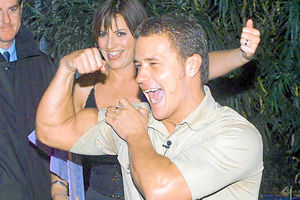
Big Brother was a surprise hit. Cheekie-chappie Shropshire builder Craig Phillips, from Newport, won the first series, and the more Endemol pushed the boundaries over subsequent years, the faster the ratings grew . . . until the pioneering social experiment morphed into a freak show and was cancelled.
Over the last decade, Channel 4 has moved more towards the mainstream, with regular sitcoms and drama replacing the more experimental stuff of the early 80s.
But one thing that is still going strong is that show that started it all. After more than 5,000 editions, Countdown has become one of the longest-running gameshows in TV history.
All together now: dededede...dededede...duh!