Distinguished legal figures to gather in Shropshire for Magna Carta talk
Soulton Hall is to welcome Mary Arden, Lady Arden of Heswall—former Justice of the Supreme Court of the United Kingdom—for a landmark lecture on Magna Carta on Friday, April 24.
Held at the invitation of the High Sheriff of Shropshire, the event features a distinguished judicial gathering, with former Supreme Court Deputy President Lord Mance also in attendance.
The event is dedicated to supporting the Shropshire Community Foundation, with the aim of raising both the profile and vital funds for the organisation’s work across the county. Lady Arden brings a wealth of experience from the very summit of the UK legal system, where she has served as a defining voice in the development of modern British law.
Her tenure on the Supreme Court was marked by a profound engagement with the most complex constitutional and commercial questions of our age. Most notably, she was a key member of the historic, unanimous 11-justice panel in the pivotal Miller II case. This landmark judgment, which ruled the 2019 prorogation of Parliament unlawful, stands as a cornerstone of contemporary law, reinforcing the fundamental constitutional principle of parliamentary accountability. Throughout her career, Lady Arden has been a trailblazer, achieving a series of historic "firsts" that have reshaped the judiciary—including her appointment as the first woman to the Chancery Division of the High Court, and later as a Justice of the Supreme Court.

The choice of venue carries a deep historical resonance that stretches back to Magna Carta’s inception through a lineage of London’s civic leadership. Soulton Hall was built by Sir Rowland Hill, the monumental Tudor statesman and the first Protestant Lord Mayor of London. Hill occupied an office first held in Magna Carta year of 1215 by Serlo le Mercer, the 3rd and 7th Lord Mayor and a key negotiator of the Great Charter. Both men were prominent members of the Worshipful Company of Mercers, an institution that very likely held a copy of the document as early as 1215.
Sir Rowland Hill himself was also a central figure in English constitutional history: for instance in the 1542 "Ferrers' Case." As Sheriff of London, Hill was committed to the Tower of London for his role in a controversy involving the arrest of MP George Ferrers. This dramatic clash between the judicial functions of the Royal Courts and the privileges of the Commons established the principle of parliamentary privilege and primacy. Notably, Ferrers was the man who produced the first English translation of Magna Carta.
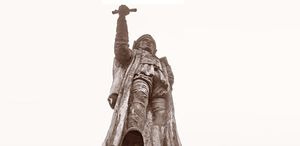
Moreover, Hill was not merely a civic leader but a judge of immense gravity, overseeing committal proceedings for treason and acting as a "pilot" through the perilous theological tides of the Reformation. His remarkable membership on inquisitorial commissions across both the Reformation and Counter-Reformation—armed with the authority to seize prohibited books and materials—directly informed the design of Soulton Hall as a sophisticated "theatre of memory."
Hill’s commitment to these legal foundations was so profound that he was immortalised in London in the 1560s and again in Shropshire in the 1790s. Atop the 110ft obelisk at Hawkstone, his statue stands holding a copy of Magna Carta, gesturing toward his Shropshire headquarters: the coded 55ft architectural cube of Soulton Hall. This geometric correspondence—with the monument standing at exactly double the height of the house—has seen Hill "waving" the Charter toward his home for centuries.
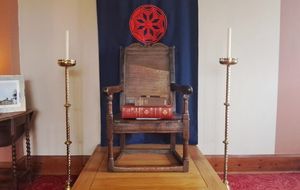
While his private library was momentously ransacked during the Civil War—an era when his "chair of estate" was also ritually broken, to be later repaired by the 1660s—the contents of his collection were of immense epistemological magnitude. In a poignant link to this history, that very chair will be present in the room for Lady Arden's lecture.
This lecture offers a rare opportunity for the public to engage with foundational legal history while contributing to a crucial local cause. The Shropshire Community Foundation provides essential support and funding for a wide range of grassroots projects, ensuring that this exploration of heritage provides a direct benefit to the local community today.
The evening event begins at 6.30pm, followed by light refreshments. Further details and ticket information can be found on the Soulton Hall website.