Nasa announces ground-breaking mission with a new probe that will 'touch the Sun'
The Parker Solar Probe will directly enter the star’s atmosphere.
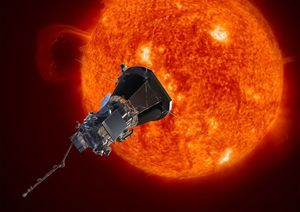
Nasa has announced a historic mission that will send a probe directly into the Sun’s atmosphere.
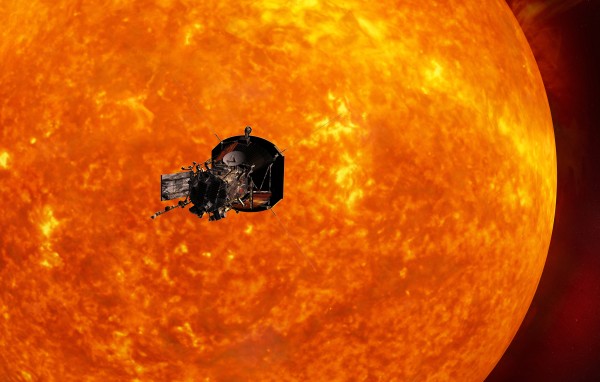
The US space agency has revealed the probe will “touch the Sun” as it flies within 3.9 million miles of the star’s surface into the solar atmosphere, which is known as the corona.
Originally called the Solar Probe Plus, Nasa also revealed it has renamed the spacecraft to Parker Solar Probe to honour astrophysicist Eugene Parker – whose work has been crucial to our understanding about how stars interact with the planets that orbit them.
The solar probe is set to launch in the summer of 2018 and its aim will be to better understand how stars work and answer questions like why the Sun’s corona is hotter than its surface.
“Parker Solar Probe is going to answer questions about solar physics that we’ve puzzled over for more than six decades,” said Nicola Fox, of Johns Hopkins University, one of the scientists involved in the project.
“It’s a spacecraft loaded with technological breakthroughs that will solve many of the largest mysteries about our star, including finding out why the Sun’s corona is so much hotter than its surface.
“And we’re very proud to be able to carry Gene’s name with us on this amazing voyage of discovery.”
The probe is expected to travel at 430,000 miles an hour and is expected to do 24 orbits, according to Dr Fox.
The spacecraft will be subjected to extreme heat and radiation from the corona, where temperatures are nearly 1,377C (2,500F).
The announcement was made during a ceremony to honour Dr Parker, a professor emeritus at the University of Chicago.
Solar GIF – Find & Share on GIPHY
Discover & Share this Solar GIF with everyone you know. GIPHY is how you search, share, discover, and create GIFs.
“The solar probe is going to a region of space that has never been explored before,” said the solar astrophysicist. “It’s very exciting that we’ll finally get a look.
“One would like to have some more detailed measurements of what’s going on in the solar wind. I’m sure that there will be some surprises. There always are.”
The probe, which is expected to come within the orbit of Mercury, will be more than seven times closer to the Sun than any spacecraft to date.
The last time a spacecraft came close to the star’s surface was in 1976, when Helios 2 achieved perihelion – point of the orbit at which it was closest to the Sun – at 27 million miles.