Nasa's Juno probe captures breathtaking new image of cyclones raging on Jupiter
“We have had to take a step back and begin to rethink of this as a whole new Jupiter.”
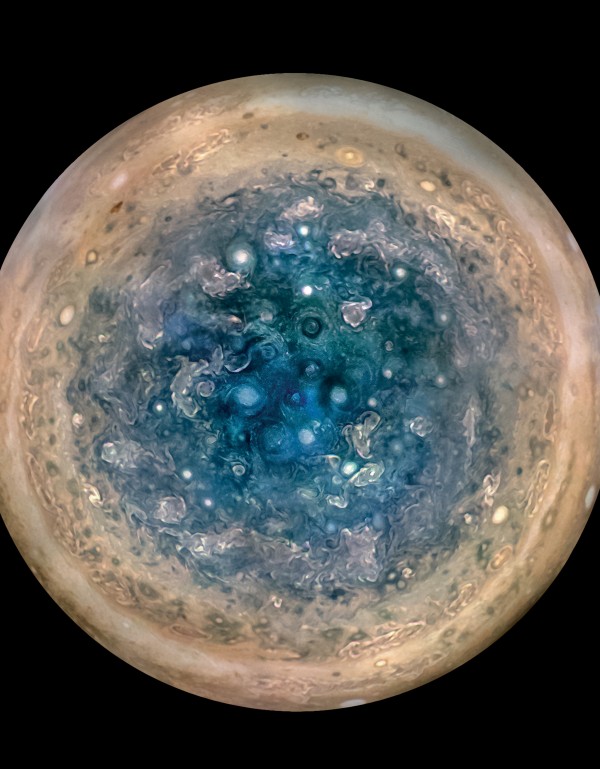
Nasa has released a dramatic new image taken of Jupiter that shows monstrous cyclones churning over its poles.
The space agency’s Juno spacecraft spotted the chaotic weather at the top and bottom of Jupiter once it began skimming the cloud tops last year – surprising researchers who assumed the giant gas planet would be relatively boring and uniform.
A recent image from the probe shows the cyclones clustered near the poles and turning anticlockwise in the northern hemisphere, just like on Earth. The diameters of some of the cyclones are believed to stretch 870 miles.
“We knew, going in, that Jupiter would throw us some curves,” said Scott Bolton, Juno principal investigator.
“But now that we are here we are finding that Jupiter can throw the heat, as well as knuckleballs and sliders.
“There is so much going on here that we didn’t expect that we have had to take a step back and begin to rethink of this as a whole new Jupiter.”
Launched in 2011 and orbiting Jupiter since last summer, Juno is providing the best close-up views ever of our solar system’s largest planet, peering beneath the clouds for a true portrait.
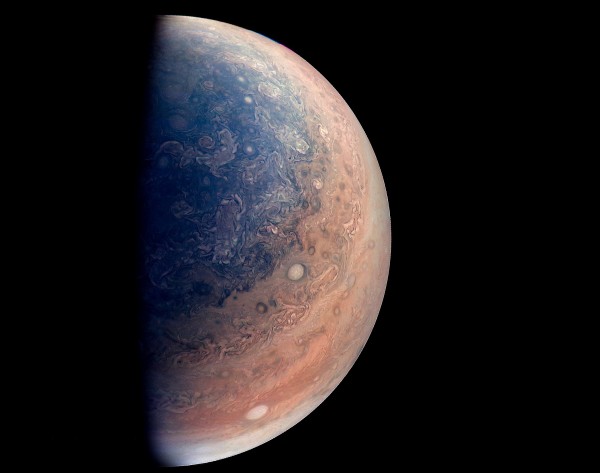
It has made five close passes over Jupiter so far, the most recent being last week. These passes occur about every two months given Juno’s extremely oblong orbit. The next one will be in July, which will be targeting the Great Red Spot.
Besides polar cyclones, Juno has spotted white ice caps on Jupiter — frozen bits of ammonia and water.
The probe has also detected an overwhelming abundance of ammonia deep down in the atmosphere, and a surprisingly strong magnetic field in places – roughly 10 times greater than Earth’s.
The results are published in Science and Geophysical Research Letters.