The world's biggest x-ray laser marks a milestone by firing its first light
The European XFEL will help scientists understand illnesses and develop new therapies.
The world’s biggest x-ray laser has generated its first light, marking a milestone ahead of its official opening in September.
The European XFEL is buried within a 3.4 km facility, most of which is located in underground tunnels, at the Deutsches Elektronen-Synchrotron research centre in Hamburg.
With a wavelength of 0.8mm and a repetition rate of one pulse per second – which will later increase to 27,000 per second – the European XFEL’s laser is extremely intense and a billion times brighter than a conventional synchrotron light source.
The x-ray can be used to make pictures and films at the tiniest atomic resolution, which will provide a detailed insight into the molecular structure of new materials, a better understanding of certain illnesses and the development of potential new therapies.
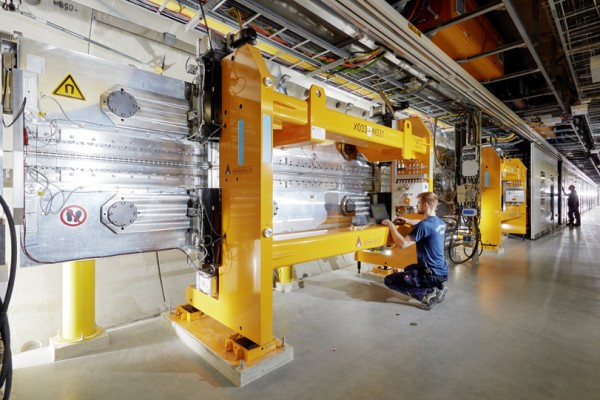
The European XFEL is not only the largest but the most powerful of the five x-ray lasers worldwide. It can generate more than 27,000 light flashes per second, in comparison with the previous maximum of 120 per second, and will allow scientists to investigate more limited samples and at a greater speed.
European XFEL managing director Prof Robert Feidenhans’l said: “This is an important moment that our partners and we have worked towards for many years. The facility, to which many countries around the world contributed know-how and components, has passed its first big test with flying colours.
“We can now begin to direct the x-ray flashes with special mirrors through the last tunnel section into the experiment hall, and then step by step start the commissioning of the experiment stations”.
The x-ray laser will official open in September and be available for experiments at the first two of the eventual six scientific instruments.