Tree in Llanymynech that has 'high public amenity value' cannot be cut down
A tree that has a “high public amenity value” cannot be cut down.
Llanymynech and Pant Parish Council submitted an application for various work to take place at the King George V playing field, off Station Road.
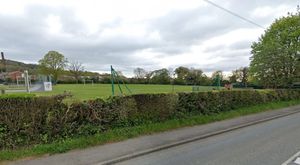
This included a mature oak tree that is growing close to the side elevation of a village hall and all-weather tennis court.
A report from Shropshire Tree Services said that, given its location to “increased target areas”, the progressive nature of internal stem decay, the requirement of repeated remedial works, and the increasing risks associated with the tree, consideration should be given for its removal.
“Any decision should be made after considering the amenity value afforded by the tree, and the financial burden of ongoing management,” reads the report.
Stephen Shields, a tree’s officer at Shropshire Council, said the tree makes a significant contribution to the landscape and character of the area, provides a very valuable habitat resource, and is an important component of the wider green infrastructure.
“It is not clear as to how the probability of failure has been assessed,” said Mr Shields.
“It is noted that the report refers to decay within the stem of the tree, which there clearly is, however, decay in older trees is common and does not necessarily significantly reduce their structural integrity.
“The presence of decay alone is not a reason to remove a tree and it is important to establish the extent, location and type of decay as well as the tree’s responses this and other information such as visual tree assessment indicators can then be used to make an assessment of the probability of failure. The report does not provide any of this information.
“It notes that the tree has been sounded using a soft faced hammer and concludes that the decay has spread in the stem, although it does not appear that the position of extent of the decay was previously recorded or by what degree it has spread since the last inspection.”
Mr Shields also rejected a proposal for a whole crown reduction to take place on a common lime tree.
“This is a large and well-established lime tree situated on the edge of the recreation ground,” he said.
“The tree is significant in the landscape and character of the area, provides visual separation between the recreation ground and the adjacent housing development and is an important component of the wider green infrastructure.”
The tree is currently around 18 to 20 metres in height, and has a canopy width of up to 12m. Therefore, a reduction of the crowd by 8m in height up 6m in width is considerable, said Mr Shields.
“The work could also reduce the life expectancy of the tree and potentially lead to decay and structural issues in the future,” he said.
“It is not clear why such an extensive reduction has been specified.
Mr Shields did, however, grant permission for work to take place on other trees in the playing field.