
History of the Wrekin's mast: A special television transmitter that caused a furore
For almost half a century, the Wrekin television transmitter has been one of Shropshire's most famous landmarks.
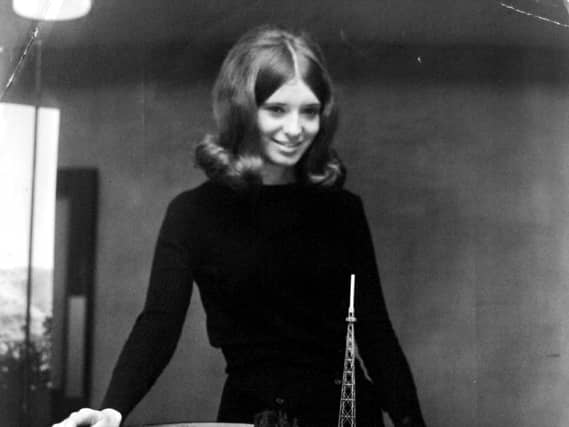


This week, plans were submitted to install new antennae to the transmitter to improve mobile phone signals.
But opinions were firmly divided when it was first built on the top of the famous beauty spot back in 1975. And strict planning conditions required that the station had to be carefully designed to be minimise the impact on the landscape.
The need for a new transmitter serving the West Midlands was identified in the early 1960s, ahead of the 1967 launch of BBC2 which brought colour television to the region. But the decision to build it on a popular beauty spot, complete with an Iron Age double fort, mean the BBC had to go through a long and tortuous planning process.
A leaflet produced by the BBC at the time explained how ultra-high frequency waves needed for colour broadcasting meant that any obstructions between broadcasting transmitters and TV aerials would cast shadows resulting in unsatisfactory reception.
The BBC explained that a suitable mast would need to be 1,500ft above sea level. Aside from the prohibitive cost, aircraft safety considerations would rule out the construction of a 1,500ft mast on the plain, meaning that a suitably high point needed to be found.
The BBC carried out transmission tests on the Wrekin in 1964, but was told in no uncertain terms that it would not be allowed to build on the landmark.
"Unfortunately, the Wrekin is a local beauty spot beloved by most Salopians, and visited by them and many others throughout the year," said the broadcaster, adding that it would assume even greater importance as the new town continued to be developed. The site also included an Iron Age double fort, which was scheduled as an ancient monument.
"Naturally, there was much local discussion about the BBC's proposals, and senior planning officers at Salop County Council felt at the time that the Wrekin should not be used for the television station site," said the BBC.
Wellington historian, George Evans, described getting 'very upset' when he read about the plans in the newspaper.
"We did the English thing and formed a committee called the Wrekin preservation committee," he said in a 2004 interview.
"We told each other how dreadful it was and wondered what to do about it."
Alternative sites at Haughmond Hill and Long Mynd were ruled out because of their impact on the aviation industry. In 1967, the Stiperstones was identified as a viable alternative, and a public inquiry in 1968 produced few objections.
However, the plan was called in by local government minister Tony Greenwood, and a second public inquiry was held in 1970 which ultimately decided that the Wrekin was the preferred site.
Strict conditions required the control building to be sunk into the hillside, and clad in dark stone to blend in with the rock. The spoil from the excavation was used to pave the service road, without the need for asphalt, and the site was unfenced to minimise the impact on the view.
The late judge Michael Mander, then a solicitor in Wellington, said many felt pressured into accepting the proposals.
"I do remember feeling a sense of moral blackmail because we were told that if it didn't go on the Wrekin, it would go on the Stiperstones."
The plans were amended in 1971 so that the transmitter would be outside the hillfort, and permission was finally given in 1972.
It was, of course, impossible to conceal the 170ft lattice tower, and the various antennae mounted on top took the total height to about 200ft.
This newspaper carried a picture of work beginning on the site in November, 1974, and the following April it was confirmed that it was due to come into operation by the end of the year. The mast was initially used to transmit BBC1, BBC2 and ITV, but provision was also made for it to broadcast Channel 4 when it was launched in 1982.
An archaeological dig took place before construction began, although nothing of note was found. Precautions were also taken to preserve the two main entrances to the fort.
The switchover from analogue television led to fresh calls for the transmitter to be removed, but by this time it had also become an important site for mobile telecommunications as well as television. And when the switchover finally reached the West Midlands in 2011, the Wrekin was used as a digital transmitter.
Comment Guidelines
Iconic Media encourages reader discussion on our stories. User feedback, insights and back-and-forth exchanges add a rich layer of context to reporting. Please review our Community Guidelines before commenting.