Flawed planning, poor engagement and missed opportunities: Scathing report on Shrewsbury gyratory scheme
Opportunities to pause, reflect and review the controversial Shrewsbury gyratory scheme were not taken, leading to the current public backlash.
That is what a task and finish group has concluded in a scathing report into the chaotic implementation of the scheme.
Featuring seven members and led by the chair of the economy and environment overview and scrutiny committee, Councillor Ed Potter, the group was tasked to examine the project around Shrewsbury Railway Station.
On November 24, members heard from several witnesses, including representatives from Shropshire Council, WSP, The Buttermarket, Shrewsbury BID, the Big Town Plan Partnership, and the Shropshire Fire and Rescue Service.
The bid submission for the project was carried out by the economic growth department within the council, and was designed and delivered by WSP and McPhillips respectively.
The project is now in the latter stages of development, and although the third stage is expected to continue, it has been paused pending an independent safety review of the designs, as well as the already-built sections of the scheme. All of the grant money has been sent though, so any additional costs will have to come from capital funding.
40-minute delays
One of the more controversial parts of the scheme has been the “floating bus stop”. A petition set up by Martin Monahan, who owns the nearby Buttermarket nightclub, to remove the bus stop and a cycle lane has reached attracted more than 6,600 signatures.
He told the task and finish group that his customers can face delays of up to 40 minutes exiting the adjacent car park due to the lights on Howard Street.
Mr Monahan believes the left-hand lane should be designated for cyclists, taxis, buses and emergency services, meaning that traffic would flow better. However, members noted that this would still result in people stepping off the bus into a cycle lane, and could make the pavement area quite crowded.
Highways officers said it was a requirement to have a bus stop to meet the active travel elements of the bid, and that early engagement with bus operators, passenger transport, and economic growth had taken place and continued during the construction.
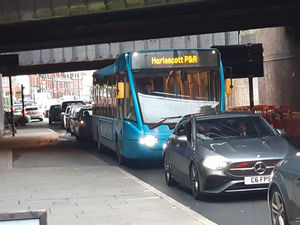
They explained a steering group made the decision to reduce the size of the bus stop, because once the ground was broken up, it became evident that in order to avoid previously undetected underground services, remodelling of the planned bus stop was necessary.
However, members understood that undertaking more detailed ground investigations early on as part of the design works might have avoided this.
They also heard that the bid had been submitted without modelling data. At that point, the scheme was moved across to the highways department.
After reports of long queues of southbound traffic on St Michael’s Street, traffic light signalling software was adjusted and changed from “optimal” operation to “vehicle detection”, which the council says appears to have had a significant improvement.
Businesses 'poorly engaged with'
Members also heard how local businesses at the heart of the scheme felt poorly engaged with. They said that, although overall footfall for the town didn’t appear to have been significantly impacted, a number of businesses had reported missed customer appointments due to traffic delays at the gyratory, and that business loading arrangements were either unsatisfactory or unclear.
A letter received from the Big Town Plan Partnership said that a number of concerns that are now being widely recognised – such as traffic performance, safety considerations, emergency access, and active travel effectiveness – were raised repeatedly throughout 2023/24.
It added that what was delivered wasn’t as described in the bid or consultation and any attempts to challenge this was not listened to. However, the partnership did say its relationship with the council was largely a positive one.
The task and finish group also met with the acting assistant chief fire officer at the Shropshire Fire and Rescue Service.
Members heard that, prior to the station gyratory scheme, vehicles could move to either side of the road to allow emergency vehicles to progress down the centre. However, the distance between each kerb was now smaller, and the road width had been narrowed.
Members learned that drivers are not encouraged to drive onto pavements to avoid blue light vehicles, acknowledging that drivers are sometimes seen to be mounting kerbs.
The fire representative said that if the central bollard – dividing the car and cycle lanes – were removed, it would provide sufficient space for a car to move into the cycle lane and allow room for fire vehicles to pass on their right.
The advice would be for cars to safely move to the left where the cycle path is, to allow fire engines to progress through the vehicle lane.
Officers left ‘feeling frustrated’
In their discussions with economic growth officers and project advisors PJA, members heard how the bid for the grant funding for the gyratory scheme was designed to fit with active travel, and the town’s movement strategy.
A significant part of the strategy is the delivery of one of the three access loops in and out of the town. This is aimed at preventing through traffic, while protecting access to, and the delivery of, a low-traffic town centre.
The “transforming movement and public spaces in Shrewsbury” project includes works adjacent to the station gyratory and was set to facilitate the delivery of one of these loops, as one of the three key gateways into the town.
At the time of the bid submission, members heard that the project was viewed as a “once-in-a-generation opportunity” to improve a busy, industrial, polluted, and dark entrance into the town.
Part of the aspiration included improved walking and cycling up Castle Street, shared with a reduced volume of traffic. However, the greater volume of traffic without the implementation of the loop meant no provision of cycling up Castle Street. This has led to the adoption of more shared space between cycles and pedestrians than originally proposed.
However, it was reported that work was done at pace, having to be delivered within strict timeframes, on a phased basis, with the loop to be delivered at a later stage.
“The project focus appears to have shifted from the initial bid, to more around traffic options, engineering and less upon active travel and improvements to the environment and public realm,” reads the report.
“Members heard that early engagement had not taken place with regards to the delivery of and changes to the scheme.
“Challenges to governance and concerns relating to technical competencies and commitment/understanding of the bid award had not been upheld.
“Officers were left having to make the best of the money awarded, and feeling frustrated that what has been delivered is not reflective of the bid that was submitted.”
‘Opportunities missed’
Members also understood that it was a large bid based upon a concept “without early enough change control, governance, evaluation and consultation”.
The report reads: “This has resulted in public backlash which could have been avoided. Commitments to outcomes and timelines were very specific and intrinsically woven into the fabric of this bid.
“As a result, opportunities for pausing, reflection and review were not taken.
“Project risk was not reviewed and actioned early enough on. Officers reported to the task and finish group that they felt this could have been paused at any point, but these opportunities were missed.”
Most senior leaders have left
Representatives from WSP told members that, while many of the day-to-day officer contacts at Shropshire Council are still in post, most of the senior lead offices have since left the organisation.
They said that highways, economic growth, and passenger transport officers had all been engaged with, and their feedback was incorporated into the preferred option, which meets legal and technical requirements.
They said changes had been made to the scheme from the inherited concept design to delivery, but maintained that there had been ” a clear path of progression”.
The report adds: “WSP added that there seemed to be a disconnect between council departments at the conceptual stage and as a client there appeared to be no consolidated point of view.
“Whilst they appeared to have good relationships with key officers, WSP did feel that validation of a decision made at the front line took a long time to make its way through various steering groups, and this meant delays to progression.
“WSP added that, from their perspective, changes could be made to re-engineer the scheme, such as removing the bus stop. However, they were unable to comment on whether implementing these changes would adversely affect or jeopardise the funding, given the scheme’s focus on promoting active travel.”
Recommendations
In total, the task and finish group has made 10 recommendations, which the council’s cabinet agreed to when it met on Wednesday (December 3).
They centre around safety and accessibility; safety and emergency services; the wider impacts; stakeholder engagement; governance and oversight; financial management; active travel and connectivity; data monitoring; learning and culture; and strategic partnership arrangements.