'Lessons to be learnt' over Shrewsbury gyratory traffic fiasco, councillors admit
Shropshire Council has been told that “lessons must be learnt” from the fiasco surrounding the controversial Shrewsbury Railway Station gyratory scheme.
A “task and finish group” has been set up to look into the finer details of what happened and what went wrong, with members set to meet next Monday (November 24).
The road network at Castle Foregate, around the station, has undergone major changes in recent months, with millions of pounds spent on the project. However, there has been major congestion in the past week, with the traffic lights sequence reportedly not working properly.
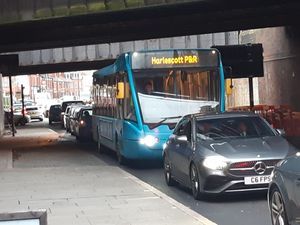
Emergency vehicles have struggled to navigate through the system, with a video taken on Tuesday (November 18) showing fire crews, with blue lights flashing, waiting more than two minutes.
Shrewsbury Fire Station is on St Michael’s Street, only a short distance from the gyratory, with fire crews needing to use the junction to respond to emergencies in a large area of the town.
Speaking at a meeting of Shropshire Council’s economy and environment overview and scrutiny committee last week, Councillor David Minnery, the chair of the Shropshire and Wrekin Fire Authority, said fire engines have been “using the cycle lane” to get away from the jams, adding that it is putting lives and property at risk.
A “floating bus stop” that has been placed in the single lane used for vehicular traffic has also caused controversy. A petition set up by Martin Monahan, owner of the The Buttermarket nightclub, to remove it has been signed more than 6,500 times.
Speaking at a cabinet meeting on Wednesday (November 19), Councillor Ed Potter, the chair of the economy and environment overview and scrutiny committee, said members have made the following recommendations:
The service director for infrastructure, in consultation with the cabinet member for transport and economic growth, to consider commissioning an independent safety audit review of the current proposals
Cabinet be asked to review the council’s strategic partnerships
The lessons learnt from this process be applied not only to future initiatives but also to existing schemes currently in operation to ensure robust governance and prevent similar issues from arising
A full report is due to be delivered to cabinet next month.
Councillor Rob Wilson, portfolio holder for transport and economic growth, said: “It’s clearly a matter of huge public interest and I think this is an example of scrutiny working at its best.
“I welcome all the recommendations. Officers are already working on a commission for an independent safety review. I welcome a task and finish group – I will be there on Monday and will very happily be as open as possible.
“In terms of looking at those partnerships, we have already held discussions with the service director for commissioning around this. I think that’s going to be a bigger piece of work which the chief executive is very much aware of.
“It’s really important that lessons are learnt and these things don’t happen again. I really hope you [Councillor Potter] can get us a report by December.
“There was an item about issues around ‘bugs in the lights’, and I think that is evident from the queues we’ve seen the last two to three weeks in St Michael’s Street. I understand people have been working on that over the weekend and the last few days. I think there’s some early anecdotal evidence that possibly yesterday [Tuesday] afternoon, some of that started to clear.”
Councillor Heather Kidd, leader of Shropshire Council, said that the most important thing is the authority has some “clear lines of accountability”, and that advice is implemented.
“Things will always go wrong, but we need to be able to put them right as quickly as possible,” she said.
Councillor Potter added that “there may not be a magic bullet” to solve the problems straight away, and there needs to be some expectation management.
“But if we can learn from this going forward, I think is one of the biggest wins we can have,” he said.
“It may take a little longer to sort out some of the more practical problems we are seeing on the ground, and that will continue behind the scenes.”