
Four activists jailed after 'extreme' protest at factory allegedly caused 'enormous' amount of damage
Four Palestine Action activists whose orgy of destruction at a factory allegedly cost a company £1.2 million, have been jailed.
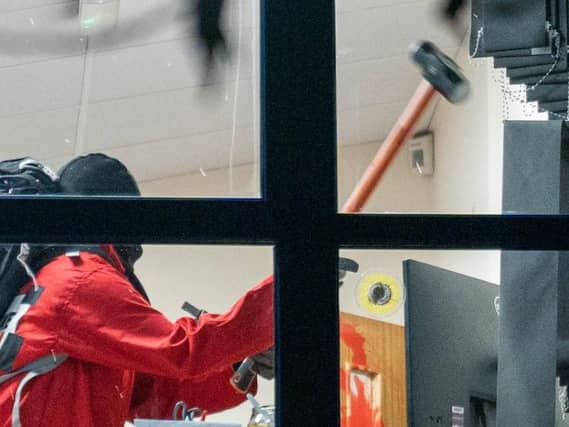

Judge Rhys Rowlands at Mold Crown Court said they had demonstrated “a degree of arrogance” as they sought to put the Teledyne Labtech factory at Presteigne in Powys, employing 64 workers, out of action for as long as they could.
Their protest was described as involving “quite extreme behaviour.”
Ruth Hogg, 40, an artist and PhD student who had been to Calais to support asylum-seekers, claimed she took part in direct action because she believed the site made component parts for weapons used against Palestinians.
Hogg, of Stanley Road, Aberystwyth, who holds a Masters degree in fine art and worked at a gallery in the Mid Wales town, denied conspiring to damage property on December 9.
She was convicted after a trial and jailed for 27 months.
Her lawyer maintained the actual bill for the damage was closer to £57,000.
The prosecution alleged it was a “professionally planned attack on a soft target, tantamount to a terrorist attack.”
Susan Bagshaw, 55, of Clawdd Helyg, Commins Coch, an artist and former social worker, Morwenna Grey, 41, of Penrallt Street, Machynlleth, described by her counsel as “hardworking, kind and caring”, and Tristan Dixon, 34, a musician, of Huddersfield, pleaded guilty to conspiracy to cause criminal damage.
They were each jailed for 23 months.
Judge Rowlands told the defendants: "It has to serve as a warning to others who might be tempted to act in a similar fashion."
He said they caused an “enormous amount of wanton damage” at a site where there was little security and a close-knit workforce.
The judge said, “distastefully”, red paint had been sprayed on a memorial to a former colleague who had died through illness.
Most of the damage was caused inside the factory by Bagshaw and Grey.
But Hogg and Dixon remained on the roof much longer, causing damage.
“This is a case of four individuals executing a previously agreed plan to cause as much damage and disruption as was possible,” the judge remarked.
There was serious consequential economic impact he said, a “sea of vandalism,” and risk to other people.
Judge Rowlands said the court expressed no view about the validity of the protesters’ beliefs.
“What you are not entitled to do is to take the law into your own hands,” he told them. “The way to change policy is through the ballot box.”
Prosecutor Elen Owen said out of £1.2 million alleged damage “consequential’ costs were put at £904,000.
Counsel had said previously that the actions of the demonstrators were “sinister.”
The terrifying raid at the factory which had chemicals risked “catastrophic” results for anyone in the vicinity – a school and houses being nearby.
The prosecutor declared: "This wasn’t a protest. It was a professionally planned attack on a soft target tantamount to a terrorist attack on people who didn’t deserve it.”
The court was told those involved were “hellbent” on causing as much damage as they could.
They were said to be “tooled up” with a drill, crowbar, sledgehammer and angle-grinder and had balaclavas and smoke grenades.
The factory produced circuit boards for various uses including life-saving MRI scanners but the intruders claimed they also made circuit boards for Israeli drones – something workers did not know.
The prosecutor told the jury in Hogg’s trial: "They targeted a small factory in rural Wales with, at best, tenuous links to the arms companies because it would give them maximum publicity for minimum effort.
"You have no actual evidence, only what Ruth Hogg has told you.”
Hogg agreed in evidence that she had drilled holes in the roof of Teledyne Labtech to allow rain inside and try and stop work there.
Questioned by her barrister, Hogg also agreed she had smashed windows after confirming with the fire service that the building was empty.
She had sprayed paint from a fire extinguisher through the broken windows.
Red paint was to symbolise the blood of innocent people who had been killed.
She said the factory also looked like a bomb had hit it.
“It’s an interesting parallel,” she remarked.
Defence lawyers said there was remorse and Bagshaw and Grey were non-violent protesters.