Christmas messages: Shropshire bishops speak of goodwill, putting others first, and reflect on tragedy and heroism after shocking Sydney attack
As we celebrate Christmas the region's Bishops have spoken of the importance of goodwill and putting others first.
Ahead of Christmas Day, bishops and religious leaders across the region have taken time to reflect on the last 12 months as they offer their guidance on what is important this Christmas.
The Bishop of Lichfield, the Rt. Rev. Michael Ipgrave, said that goodwill is for life, not just for Christmas as he reflected on the tragedy and heroism seen in the appalling Sydney terror attack.
He writes: "At this time of year, many still seek out the 1946 film, “It’s a Wonderful Life.” In it an angel visits a frustrated businessman at Christmas.
"The angel shows him the value of his life, letting him glimpse how things would have been if he had never been born.
"How then to value the birth of Jesus Christ, the baby whom Christians acclaim as Emmanuel, ‘God with us’? The angels’ message on a hillside by Bethlehem over 2000 years ago: ‘Peace on earth, goodwill to all’ has given us the enduring association of ‘goodwill’ with Christmas.
"Goodwill, that subversively inoffensive Christmas gift, can nudge us into a generous act, a kind word, a forgiving conversation, being less grumpy and can even transform relations between people and groups.
"Showing goodwill puts others first whether we hardly feel it or if it comes at great cost or risk to our life.
"Recent barbarous events in Sydney moved me to great sorrow and much prayer, and also showed the power of goodwill.
"Ahmed al-Ahmed, a bystander, put himself at grave risk, halting a terrorist’s murderous rampage through those celebrating the Jewish festival of lights, Hannukah, which prompts adherents to acts of kindness.
"His actions were costly for him; for those whose lives were spared, they were transformative.
"His act brought light into the darkness of murder. He did not ask who those at risk were; he did not check that they were people like him; he did not judge whether they deserved to be saved; he acted because goodwill to others flourished in his heart.
"Goodwill is and always should be gloriously indiscriminate. In this case, its unfettered power was that a Muslim man defended a Jewish community in a country where the majority affiliation is Christian.
"That is deeply subversive: reminding us that goodwill is for all, just as the God who comes at Christmas is for all, and also not just for Christmas, but forever too.
"Likewise, the goodwill the angels proclaimed is not just for a season but for an age lasting for as long as Christ is with us: also forever.
"In an era where we are rightly concerned about those who are weaponising and politicising Christian faith, perhaps the antidote is instead to weaponise goodwill.
"As a feeling on its own it will achieve nothing, but if we let the feeling prompt us to action it can light a thousand candles in the darkness.
"As the poet Henry Longfellow wrote:
“God is not dead, nor doth He sleep;
The Wrong shall fail,
The Right prevail,
With peace on earth, good-will to men.” (19th century archaic language)
"May you have a joyous Christmas in which much goodwill flows."
The Rev Richard Jackson, Bishop of Hereford, spoke of the importance of kindness, humanity, and love.
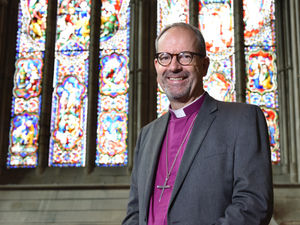
He writes: "The comic Spike Milligan requested his gravestone should carry the inscription, ‘I told you I was ill!’ The church authorities weren’t enthusiastic and refused. However, Spike had the last laugh. If you visit his grave today you will find the inscription there as requested; its just written in Greek!
"Many historic figures are known as much by their title as their name. We have Alexander the Great, Ivan the Terrible and even Vlad the Impaler! I wonder what word people might use to sum us up in 100 years; if they remember us at all.
"The Christmas story in the Bible gives titles to some of the characters. Even a bit player like Joseph gets one. In Christ’s life he appears infrequently and only in the first few years, disappearing after the incident where Jesus is left behind in the Temple by mistake. He is described as a righteous man. It shows in his kindness to Mary. If Mary had become pregnant in the normal way of things he could have chucked her out, shamed her publicly and condemned her to a horrible future. He responds to her vulnerability with kindness. He showed a humanity and love that responded to a vulnerable young woman.
"Jesus gets a title too. He is described as Emmanuel: God with us. In a sense Jesus only gets to fulfil that role because of Joseph’s kindness and Joseph and Marys’ preparedness to live with the whispers and accusations of illegitimacy. Joseph stood by Mary in her hour of need. Jesus shows us that God stands with us in ours. God is not indifferent to human suffering but deals with the root causes of it. Christians understand this need is much deeper than first appears. We need saving from ourselves. As St. Paul said, “all have sinned and fallen short of the glory of God”. Left to our own devices we’re estranged from God who is the source of life. All that is wrong in the world is a symptom of that. We believe that Jesus, God with us, through his life, death and resurrection bridges the gap. Christmas is the start of a story that finishes at Easter. A very happy Christmas to everyone and may you know Jesus with you in the year to come."
Rt. Rev. Mark Davies, Roman Catholic Bishop of Shrewsbury, speaks of the importance of Christ remaining central to the celebration of Christmas - and how the removal of Christian element can create a "dangerous vacuum for something more sinister"
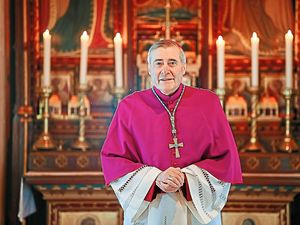
He writes: "The national flags which suddenly appeared in communities across the country, were among the most unexpected events of 2025. In some of our most deprived communities the vast number of these flags was something I had never witnessed before. Many commentators offered interpretations as to what motivated this ‘summer of flags’, whether simple love of country, a renewed valuing of our national inheritance or an indication of the rise of a sinister nationalism. I can claim no special insight into the motivations, which may have been many and varied, except to ask whether this perceived need to fly the flag in such an unprecedented way indicates a deeper search for identity. The shared and inclusive identity which has long been rooted in our celebration of Christmas and the inheritance of faith and charity which has flowed from it.
"The flags which lined so many streets and roadways, were emblazoned – whether recognised or not - with the Cross of Christ and his saints reflecting the faith on which our society was built. For the deepest identity of our nation has never been rooted in crude nationalism, rather in all we have celebrated together at Christmas. It is this faith and charity that has formed our life as a society and been expressed in the goodwill we owe to each other. Christmas celebrates the love which changes the way we see ourselves, the love which went as far as God becoming man to save humanity.
"If we are in danger of forgetting what we nationally celebrate at both Christmas and Easter, then we are also in danger of losing the light which has guided our national story, without which we could not begin to understand ourselves. For the very years of our lives, as that of our whole history, are numbered from the birth of this one child in Bethlehem, “a saviour born for us.” The days of our week begin each Sunday, on the day of His Resurrection, giving to time its purpose and meaning.
"We cannot fail to recall that the totalitarian ideologies of the past century, sought to remove Christ’s Nativity and Resurrection from the calendar and from the shared memory of society. The Christian festivals were replaced with celebrations of pagan nationalism or the worship of state, race or party. I fear the recent efforts we have seen to remove Christ from our celebration of Christmas likewise serves to detach our society from its very foundation. The loss of shared Christian memory, whether by design or default, provides a dangerous vacuum for something more sinister than inane winter festivals.
"The Christmas lights, which at this moment of the year illuminate all our streets and roads, gently recall that sure light which has guided the best in our history. In these increasingly unstable and uncertain times, we will always find in the light of Christmas, our truest guide."