Watch: I got to meet Shropshire hospital’s surgery robot and hear how it is transforming operations for patients
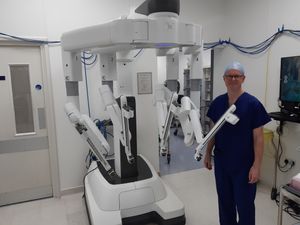
Surgeons at a Shropshire hospital are using the coolest piece of technology to help them carry out surgery on patients… and I got to see what it’s like to be at the cutting edge.
If your idea of an operating theatre is of a team of people handing scalpels and saws to each other while the surgeon asks for their brow to be mopped, that’s way out of date.
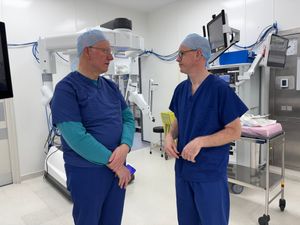
These days it’s all about the robot that assists the team, with the surgeon not even standing next to the patient.
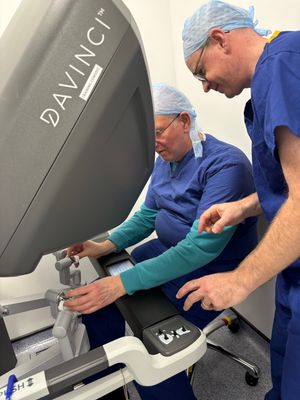
The surgeon sits in a corner of the operating theatre using what looks like a seaside arcade computer game.
Its display shows close up images of inside the patient’s body for them to guide equipment to precisely where it is needed.
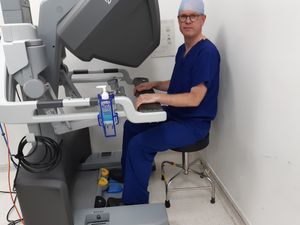
Adam Farquharson, clinical director of gastrointestinal surgery at Shrewsbury & Telford Hospitals NHS Trust (SaTH) explained how a detailed 3D picture of the inside of a patient’s body can allow him to avoid even the tiniest of blood vessels.
Don’t worry though, nobody is about to allow a clumsy reporter who makes a habit of dropping his notepad to get inside Mrs Miggins’s gall bladder.
But Mr Farquharson did allow me to use a simulator with precise finger controls to pick up items and place them elsewhere on the screen. It’s what I imagine surgeons have at home for their children to play on.
Mr Farquharson says the investment in the Intuitive Da Vinci Xi system in 2023 has been transformative for patients, the strategic importance of RSH, and for staff who are wanting to join the robot-assisted team.
SaTH is attracting more top notch surgeons to work in Shropshire as a result of making the investment, Mr Farquharson says.
Since first plugging the four-armed robot and all its paraphernalia into the mains the surgeons have performed ops on more than 500 patients.
By carrying out up to eight ‘high volume, low complexity’ surgical procedures such as on hernias or gall bladders each day, five days a week, they are increasing the productivity of the trust.
If major operations need to be carried out, it can be used to complete two or three of those each day.
The trust is also seeing benefits in reducing the number of times patients have to come to the trust’s under-pressure accident and emergency department with complications.
Women who have had a hysterectomy can now go home on the same day as their surgery. This makes the RSH “one of the best in the country,” said Mr Farquharson.
And hospital discharges after some cancer operations have reduced from five to three days.
Mr Farquharson described the system as an “evolution of keyhole surgery” which is now the standard of care.
But instead of using a thin, lighted tube called a laparoscope to examine and operate inside the body it is using the robot assisted system to make the work even more precise.
SaTH says it made a £1.8m capital investment in the surgical robot in 2023. The cost benefits of it are approximately £750,000 to date.
Mr Farquharson is a huge fan of robot assistance which he says “secures the regional strategic position” of the Royal Shrewsbury Hospital.
“We are recruiting more high calibre surgeons who are keen to work with the robot,” said Mr Farquharson.
“We are planning to expand the use of robotic surgery across the trust.”
As well as having an element of artificial intelligence (AI) the display can be accessed by surgeons all over the world for training or to make use of their specific expertise but not to carry out operations remotely.