Farming in a brave new world
The farmer 2018.01 January Hereford Grassland Society
Silage competition winners and Liam Sinclair
The results of the Hereford Grassland Society’s 2017 silage competition sponsored by Wynnstay Farmers were announced at its meeting in early January by Dr Huw McConochie, Wynnstay's head of technical services.
Dr McConochie said he had seen some first class well-made silages during his visits around the county and speaking about silage generally he warned about the risks of taking silage analysis figures too literally.
“Silages can look good on paper, but do not perform so well," he said.“It’s what the cows tell us.”
He went on to stress the need to balance supplementary feed correctly.
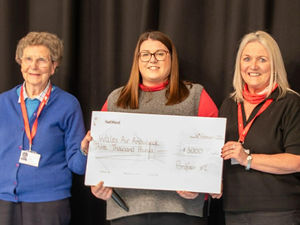
John Hawkins, from Bringsty, near Bromyard won the Grass Silage class and Mike Davies of Canon Pyon took the Maize class. The Davies family had won the Grass Silage competition three years after the Society was founded 60 years ago.
Later in the evening Professor Liam Sinclair, a lecturer and research worker from Harper Adams University who had been a student at Aberdeen University, spoke about the challenges and opportunities facing the livestock industry, in what he described as “a brave new world.”
Having been brought up on a Scottish beef and sheep farm, he knows what makes farming tick and spoke about some of the challenges ahead. He drew attention to the forecast need to produce as much food in the next 50 years as has been produced over the millennia. He added that demand would by partly fuelled by not only by the increasing global population but would be exacerbated by the rise in the numbers of the affluent middle-classes changing diets towards meat and dairy products.
He pointed out the growing populations would put more pressure on land as the area of land per head of population will drop from 0.4 to 0.13ha per head over the next few decades which coupled to climate change and the increasing demand for fresh water would put tremendous pressures on food production.
In questioning what can we do about it he asked “can we produce more?” which led him to say we have three incredible tools; biological technology; data storage and handling through increased computing power as he said “it’s all about numbers”; artificial intelligence.
He then went on to expand on the biological revolution created by the discovery of DNA and referred to the creation of Dolly the Sheep as an example of what could be achieved. He said genetic progress would be the equivalent in food production to the industrial revolution of the 19th century as it has power to make changes faster by being able make selections quicker as new cell technology can lead to the ability to create genetic variations and modifications more rapidly, reducing what now takes five years down to two by being able to predict using tissue samples. Those new techniques will have a rapid impact through genetic selection and turnover, not only on traits such as growth rate and yield, but on a whole range of other factors such as milk quality and carcase confirmation and saleable meat yield and disease resistance which collectively would enhance the industry’s competitiveness.
As an example, he cited what the effect could be on the sheep sector. He said productivity could be doubled through improved rumen function, higher lambing percentages, faster growth rates and improved carcase quality, including better eye muscling, a reduction in disease such as lameness, while at the same time reducing the environmental impact which will gain importance as Mr Gove moves towards what will follow Brexit.
Liam asked where next? He said innovations improve through use, but warned regulation will inhibit progress in the UK and the EU and was adamant the assessment of technology should be based on outcomes, not the technology used.
He finished by saying genetic advances will improve efficiency, the environment, animal health and welfare, food quality and safety and human health.