'Can do' attitude impresses judges
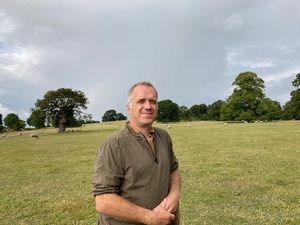
By Keith Stevens Peter Lowe and his wife Philippa run a 50-acre Staffordshire County Council tenanted grass farm between Eccleshall and Newcastle, where at present they keep 625 ewes and rear 200 intensive beef sold at 500kg, that they buy in as two to four-week-old calves.
His husbandry, business acumen and “positive can do attitude” so impressed the Staffordshire Agricultural Society judges that Peter won the smaller farm category and beat all the well-known larger scale farmers to take the overall champion farm award.
The judges John Heath looking at the smaller farms and Andrew Blenkiron judging the championship, both referred to his “refreshingly positive, can do attitude”, and “his general enthusiasm for the industry, in the current age of uncertainty”.
“ His livestock were a credit to him and his business mix for a small unit was well thought out,” the judges said. “His attention to detail was obvious.”
Peter’s brother farms with his mother at the family’s farm in the Staffordshire Moorlands, and that is one of the farms he sends his ewes and lams to for summer grazing, the others are all relatively nearby to School Farm.
Peter took his agricultural degree at Reading University , where he met farmer's daughter Philippa Edge who was reading geography. Finishing in 2004, he returned home for three years before taking an MSc in Rural Environment and Amenity Land Management at Harper Adams University College. He then joined Hinson Parry at Newcastle, Staffs, for three years where he gained his full qualifications as a chartered surveyor. But during this time he and his wife who runs her family’s sectional timber building company at Ashley, started to build up a sheep flock of their own and when the opportunity to rent a farm in the right location came up they wanted to be 'proper farmers'.
“I just love farming, my family, Pip and the boys come first, but farming is what makes me tick," he said. "Being outside to enjoy the scenery, free to be my own boss, with the rewards of seeing the cycle of livestock flow with the seasons and animals reach their prime, a job couldn’t be more rewarding. It’s not all fantastic, there are the problems, there are times when I’m short with folks when I shouldn’t be and times when it’s not just my socks that are falling off, but most of the time even when it’s rained continually for a month and my water proofs need waterproofs I’m still loving it.”
Peter married Philippa in 2009 and they have two sons Thomas and Jack. They thought very carefully before tendering for the 10 year FBT tenancy off the Council for School Farm, Standon Bowers, in July, 2012. This small ex-dairy farm wanted a lot doing to it, both in the house and the buildings if it was going to suit their requirements, but they went for it largely based on its location. To adapt it to their requirements they have needed to investment a significant amount of capital into the buildings, land and farmhouse, but with only five years to run the time has come to stop spending on the property.
The Council paid for the frame and roof of one beef rearing shed, another shed was bought by Peter and Philippa and dismantled from a Council farm at Yarlet near Stafford. The old milking parlour and collecting yard was totally removed and another shed was stripped out and re-clad in timber space boarding. All the buildings have been kitted out with purpose built penning. When not used for lambing, the old milking parlour and collecting yard building is now the calf shed for their batches of 60/70 calves which are reared three times a year. The bull calves, mainly Holstein are bought through Meadow Quality. Peters preference is for Holsteins as they typically reach the necessary P+2 finishing grade, and are 50kg heavier when compared to Friesians which might grade better but command no higher price on the Buitelaar scheme.
Calves are fed milk replacer until reaching 90kg in about 4-6 weeks, then on Massey Feeds starter pellets for a month, when they next go onto an 80 per cent rolled barley and 20 per cent protein pellet ration, the protein pellet is fully mineralised and contains yeast and limestone to reduce the risk of acidosis, the finished ration is 12 per cent protein and has a 45 per cent starch and sugar content. All feed is ad lib to finishing and straw or dry haylage is offered alongside the barley ration. The bulls usually outgrown the calf shed 4 weeks after weaning when they are moved to purpose built steel penned covered yards, designed to be easily managed by just one person to clean out and bed down.
Baby calf health and growth is monitored by weekly weighing and temperature checks to keep on top of any bugs or pneumonia. Older animal are weighed monthly to ensure bulls are achieving satisfactory growth rates. With the mix of calves bought in from different farms, illness particular pneumonia is difficult to completely eliminate, and antibiotic treatment is necessary more frequently than Peter would like. This he believes is an inherent problem with rearing dairy bull calves and is something which appears to be getting worse year on year.
Peter is focused on the long term development of his commercial flock of 625 ewes and hopes to improve production by retaining his appropriate ewe lambs to produce ewes suited to a grass and forage based system. In the early years Peter used pedigree Texel rams, but he found these struggled to keep up with the rigors of serving ewes at grass, and the offspring were difficult to flesh of grass alone.
More latterly, Peter has been looking at using composite rams and has tried Texel cross Charolais, NZ Texel and this autumn he used Aberfield and Abermax rams from Innovis. His hope is that by using rams bred and reared of grass and forage alone he will be selecting the genes which will enable his flock to excel on grass and that the longevity of his rams will be greatly improved. In this breeding year three Aberfields served 150 North Country Mules and 100 Texel cross ewes, one NZ Texel served 80 Cheviot Mules, and one Abermax served 100 Texel cross ewes. Whereas, 6 pedigree Texel or Texel cross Charolais rams only managed to serve 200 Texel cross ewes, with the pedigree Texels only managing two weeks of service before they were worn out and became idle.
The ewes are due to lamb in April in order to coincide with the Easter holidays when six students will be joining the family to help with lambing. Peter would ideally like to lamb outside but realises that if he were to do so he would spend more time driving roads than spent managing the sheep. Therefore, all ewes will lamb indoor in order to hold back enough of the spring grown grass to turn out all freshly lambed ewes on the 50 acres at School Farm. Once the main rush of lambing is complete, a proportion of the ewes and lambs are then moved away from School Farm to their summer grazing. The 116 triplet bearing ewes are brought home from winter grazing in February and are kept inside until lambing, the roughly 405 twin bearing ewes will return in mid March and the 104 single bearing ewes just in time for lambing. Alongside haylage the triplets are built up to 800 grams and the twins 400 grams of concentrate feed before lambing. This haylage is made in June, when flushes of grass require cutting to enable the four acre electric fenced paddocks to remain within the grazing rotation.
At School Farm the ewes are grouped according to the lambs age in mobs of 150 ewes and their lambs spending the spring and summer rotationally grazing 4-5acre paddocks which are created with temporary electric fencing. These paddocks are managed for grass growth with any surplus grass been cut and baled at the first opportunity in order to bring the paddock back into the grazing system. Although Peter would like to operate this system on all the land he grazes, this is not possible due to restrictions imposed by the various land owners under environmental stewardship schemes. Peter believes the rotational grazing system not only produces an extra third in terms of grass production but also reduces the worm burden, the extra grass enables stocking rates at School Farm to be pushed to seven ewes and their lambs to the acre.
The first crop of wether lambs is usually ready to market in early July and are usually sold through local auctions, with the current aim being to market all ¾ bred Texel lambs before weaning at the end of August. A large proportion of Peter’s ewe lambs are kept back for breeding, he is aiming to build up to a 1000 strong ewe flock within the next couple of years. At the present time the other ewes lambs are sold for breeding either in the Autumn sheep sales at Bakewell market or privately from School Farm, but in the future Peter would like to retain all ewe lambs, keeping the best for himself and selling the rest as Shearlings. Although Peter believes land occupation isn’t his driving factor he thinks it’s likely in two or three years’ time he will be summer grazing 250-300 acres on various agreements, all from his School Farm base.
“Back in 2012 I didn’t think I could manage more than 300 ewes on my own, but then I bought a good sheepdog and a quad bike, and I now manage 600 ewes and their followers without too much difficulty. Electric fencing a 40 acre field in a couple of hours in the autumn with my quad and auto wrapper doesn’t seem like such a big job, but when its early January and there are 1400 mouths to feed, fencing and moving sheep can seem a full time occupation. It’s a good job I love it”.
All sheep are on the Heptavac P vaccination programme and are vaccinated for Orf, all breeding ewes are vaccinated for Enzotic and Toxoplasmosis Abortion, and are treated with Footvax at least once a year but usually twice a year, often foot vaccinating the ewes before turning them onto their winter grazing on other farms. The ewes are mineral bolused before going away for the winter , whilst in the summer the Tythebarn company have prepared a mineral lick to complement any deficiencies in the farm’s grass leys. All lambs are treated against coccidiosis at six weeks of age, which coincides with the first vaccination of Heptavac P. Peter says “Rotational paddock grazing is a big help against worms but the ewes are dosed at lambing to ensure the ewes are going onto clean paddocks. Lambs are treated with a long acting wormer in early summer, after that a white drench is used to treat any individual lambs with dirty back ends as and when necessary, but I rarely treat more than a handful at one time”. In 2013, shortly after moving to School Farm the flock was struck with an outbreak of Enzotic and Toxoplasmosis Abortion, which Peter describes as one of the lowest points in his farming career. In that year 30 out of a flock of 300 ewes went without rearing lambs, and the number of single lambs being reared was much greater than usual. As a result of experiences such as this Peter has taken the approach of proactively vaccinating where possible, “losses, death and suffering is something that can very quickly get you down, so if it’s possible to avoid both the emotional strain and financial losses, I take that option”.
“School Farm has been the ideal farm for us.” he said. "We could not be happier than where we are, surrounded by neighbours that we have a good working relationship with. At the moment we struggle to see how we could move our business to anywhere else, but with less than 6 years remaining on the tenancy we must keep our minds open to doing so.”
Peter has built strong working relationships with many neighbouring farmers buying in barley for his bulls, swapping straw for muck, grazing rough land not suitable for dairy or arable farming, grazing surplus winter grass on dairy farms and buying in or growing stubble turnips as part of other farmers’ arable rotations.
“If at the end of our ten years on this designated starter farm, we are obliged to move on, then we will find our way to the next challenge.” he added.