New wetland created at Shropshire farm in project to find nature-based solutions to tackle flooding
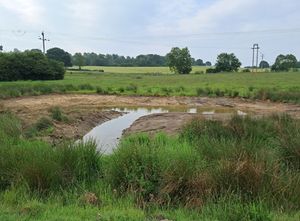
A new wetland area has been created on a Shropshire farm as part of a pioneering project to reduce the risk of flooding using nature-based solutions.
It's hoped a new wetland at Cruckmeole Farm near Shrewsbury will provide an estimated 400 to 500 cubic metres of water storage.
The new wetland forms part of the Rea Brook demonstrator project - one of eight projects managed by Shropshire Council, informing the Severn Valley Water Management Scheme (SVWMS) that seeks to tackle flood risks and improve water resilience across the Upper Severn catchment in both England and Wales.
Proposals for the new wetland were put forward by the landowner, who wanted to reduce the risk of flooding to a nearby A-road and surrounding areas.
Working in collaboration with the Severn Rivers Trust, which is delivering the Rea Brook demonstrator, the wetland was carefully designed to balance ecological sensitivity with practical flood mitigation.
Constructed in June, its design features a large offline pool and a series of smaller scrapes that are designed to slow the flow of water from surrounding hills and residential areas before it reaches the Rea Brook.
Cecilia Young, catchment officer with the Severn Rivers Trust, said: "The design was carefully adapted following ecological surveys to protect species-rich habitats, demonstrating a commitment to biodiversity alongside flood resilience.
"The project also served as a test case for navigating planning and regulatory frameworks, resulting in a unique agreement between Shropshire Council and the Rea Internal Drainage Board to streamline permissions under the Demonstrator scheme.
"We are looking forward to collating the data and seeing how this wetland will prove the benefits of nature-based solutions to water management."
Shropshire Council said monitoring equipment, including a camera trap and gauge board, will be installed at the wetland to track its performance over time.
This data will help assess its flood storage capacity and inform the future rollout of similar nature-based projects across the Severn catchment.
Tom Dainty, Shropshire Council deputy cabinet member with responsibility for the environment, added: "This project is a testament to what can be achieved when landowners, local authorities, and environmental organisations work together.
"The landowner’s vision, flexibility, and commitment were instrumental in overcoming challenges and delivering a wetland that will benefit both people and nature."