Newport students helped unearth Roman coins and metal acorns on Attingham dig
Students from a Shropshire grammar school helped uncover the hidden histories of the Attingham Estate near Shrewsbury.
Over two weeks in September, archaeologists led by Time Team’s Matt Williams worked alongside volunteers and members of the public to explore three trenches and several test pits on the Attingham Estate near Shrewsbury.
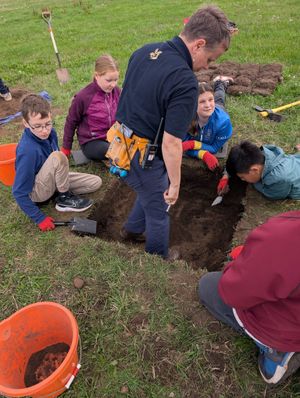
Twenty-nine service pupils - those with a parent or carer serving in the armed forces - from Haberdashers' Adams Grammar School in Newport also joined the dig for a day.
The excavations followed a geophysical survey across more than 1,000 hectares of the Attingham estate.
The survey was conducted as part of efforts to restore nature on the estate, enabling the National Trust to work with tenant farmers to create habitats while protecting important archaeological remains.
The survey had uncovered evidence of Roman villas and an Iron Age homestead.
Suzy Watts, a former regular in the RAF and volunteer with Adams’ combined cadet force, is the archaeological project manager at Attingham Park.
Service pupils were given the opportunity to take part, as part of Suzy's 'Wings to the Past' project, which provides archaeology opportunities for service personnel and their families to support wellbeing.
Back in July, Suzy ran a workshop that introduced the pupils to archaeological excavation. They learnt about geophysical surveys, surveying techniques, finds washing and processing.
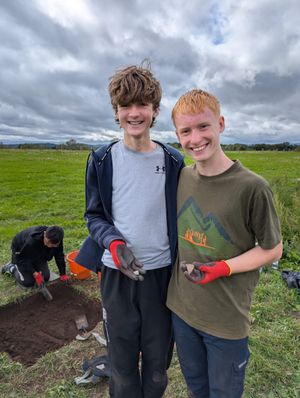
On the dig in September pupils were able to get their hands dirty, exploring test pits and sieving through the soil, to see the extent of a possible settlement.
Artefacts unearthed included Roman coins, a decorative metal acorn, a military helmet handle, the ceramic base of a candlestick and part of an incense bowl.
Finds from the dig will go on display to the public in 2026.