Watch: Telford university students to race in Formula 3 championships
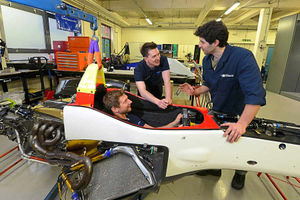
Bolt by bolt, quickly but precisely, two young men in blue overalls dismantle the highly tuned suspension of a racing car.
"We've just been removing the wishbones for rebuilding," says Chengyang Liu," as he takes a quick breather.
"It's quite exciting."
Nathan Tupper, 22, adds: "I have always been very interested in motorsport, from Jenson Button's win in 2000, and even Damon Hill in the late 1990s."
A few yards away, racing driver Shane Kelly looks on approvingly, speaking confidently about his chances in the forthcoming Formula 3 season as he stands in front of a silver Formula 1 car.
But this is not the pit stop at Brands Hatch, it is an engineering workshop in Telford belonging to Wolverhampton University.
And Chengyang Liu and Nathan are students. The university's school of engineering at the Telford Innovation Campus in Priorslee will be entering a team in this year's Formula 3 Championship. And Shane, who will be the driver, is bullish about the team's chances.
"I think we stand a good chance," says the 36-year-old, who earlier in his career raced against a young Lewis Hamilton.
His confidence is boosted by the team's successful first season in the Monoposto Championship last year, which saw Shane triumph at Silverstone in a Formula Renault car rebuilt by the students, and ultimately taking fourth place over the course of the season.
But Shane, whose driving skills have also seen him appear alongside Brad Pitt in the motor-racing film Fury, and also in racing biopic Rush.
"Formula 3 is probably the equivalent of the Football League Championship," he says.

Race engineer Matt Fenton adds: "In terms of the technology, we're probably a couple of years behind Formula 1, the new developments come to Formula 1 first, then Formula 3 will get them a couple of years later, and eventually they will filter down to road cars."
Another bonus of entering a team in Formula 3 is TV coverage, as the season will be shown on the Motors channel. Principal lecturer Dave Tucker hopes this exposure will change people's perception about engineering.
"A few years ago engineering had a bit of an image problem," he says.
"There used to be these terrible posters of a man in goggles, with maybe a few sparks flying, and people don't really know what engineers do.
"We hope this will make people realise what it is all about."
Certainly, it has made an impression on Chengyang Liu, who swapped his native China for Shropshire to enrol on the university's Automotive Systems Engineering course.
Engineering is a big thing at Wolverhampton University, and the college has committed to investing £12 million in the campus at Priorslee.
The new centre will include a wind tunnel, engine test facilities, 3D printing facilities and laboratories, and students will also be able to study specialist electronics and telecommunications.
It will be followed by the introduction of food engineering and aerospace engineering in 2016/17.
Dave Tucker says experts have forecast that within the next four years there will be a shortfall of 200,000 qualified engineers in the UK, and that taking part in the racing team gives them the sort of experience that employers want.
"Cars have remained more or less the same for so many years, but now there is a big shift with the development of new technologies, with hybrid and electric cars, and driverless cars," he says. "Companies like Jaguar Land Rover are absorbing graduates at an unbelievable rate, because they are problem solvers.
"This goes a long way to providing the experience they are looking for. We are competing against international teams, and we are winning."
Dave is in no doubt that the success of the team is in no small part down to the dedication of the students
"Universities are always striving to make group work and teamwork successful, and there's no substitute for the real thing," he says. "It's credit to the students, they have grabbed the opportunity with both hands.
"It's a big ask when we have about 10 to 15 students trackside, and that involves giving up 10 weekends of the year, early-morning starts and driving maybe 100 or more miles to a track."
Of course it wouldn't be motorsport without a few hiccups along the way, but Dave is a firm believer that these mishaps are a crucial part of the learning experience.
And he says the rewards can be huge, with several members of last year's racing team having moved on to exciting new jobs in the automotive industry.
"We're giving them real-world access to motorsport and there are plenty of early starts and late nights involved and this gives them all great confidence," says Dave.
"There aren't many motorsport courses at universities where students get to be part of an actual race team. We aren't just talking about motorsport in a classroom, we're doing it."