Women have more babies in West Midlands than anywhere else in the UK - find out how we are top of the fertility chart as other regions see big decline
Fertility rates in the West Midlands are on the up – bucking a national trend that reveals a record low.
The rate for England and Wales has fallen for the third year in a row, alarming experts in the field.
The total fertility rate across both nations - defined as the average number of live children women would expect to have across their childbearing life - stood at 1.41 in 2024. This is down from 1.42 in 2023 and is the lowest since comparable data began in 1938, according to the Office for National Statistics (ONS).
But new figures show that the West Midlands now has the highest fertility rate in the country, at 1.59. That compares to the lowest in the south-west of England at 1.31.
In the West Midlands, only Shropshire and Cannock Chase have a figure that is below the national average, with all other regions ranging from 1.43 to 1.91.
For a country's population to remain stable over time - discounting any impact from migration - the total fertility rate needs to be around 2.1. The drop in the rate comes despite the number of births in England and Wales increasing slightly last year from 591,072 to 594,677. But this was offset by a jump in the size of the overall population, meaning fertility rates fell overall.
Most regions saw a drop in the total fertility rate, with only two - the West Midlands and London - seeing a year-on-year increase.
The figures come just a day after Scotland's total fertility rate was also confirmed to have dropped to a new record low, falling from 1.27 in 2023 to 1.25 in 2024. The latest rate for Northern Ireland is due to be published later this year.
Greg Ceely, ONS head of population health monitoring, said: "Fertility rates in England and Wales have been in overall decline since 2010.
"The total number of births increased last year, for the first time since 2021, but this was offset by population growth.
"As a result, fertility rates fell overall, and are now at the lowest rates on record."
At a local authority level, Sandwell in the West Midlands was among the areas with the highest rate, at 1.91 children per woman. Luton in Bedfordshire had the highest total fertility rate at 2.0, followed by Barking & Dagenham in London (1.99) and Slough in Berkshire (1.96).
The City of London had the lowest rate (0.32), followed by Cambridge (0.95), Brighton & Hove in East Sussex (0.97) and Islington in London (0.99).
Newport had the highest local rate in Wales (1.64) while Cardiff had the lowest (1.19).
Fertility rates in 2024 and, brackets, in 2023
Sandwell 1.91 (1.8)
Walsall 1.80 (1.75)
Wolverhampton 1.80 (1.81)
Birmingham 1.75 (1.61)
Dudley 1.60 (1.62)
Telford & Wrekin 1.53 (1.54)
Lichfield 1.47 (1.47)
Wyre Forest 1.50 (1.46)
Powys 1.43 (1.49)
South Staffs 1.44 (1.40)
Stafford 1.43 (1.41)
Shropshire 1.40 (1.43)
Cannock Chase 1.39 (1.55)
Education Secretary Bridget Phillipson has called on Britons to consider having more children and having them sooner, warning of the "worrying repercussions" posed by the decline in fertility rates.
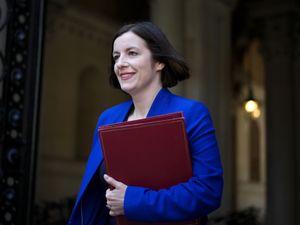
"A generation of young people have been thinking twice about starting a family, worried not only about rising mortgage and rent repayments, wary not only of the price of fuel and food but also put off by a childcare system simultaneously lacking in places and ruinously expensive," she said in June.
The specific fertility rates for England and Wales show slightly different trends, with the rate for Wales dropping from 1.38 in 2023 to 1.35 in 2024, while the rate for England is unchanged year on year at 1.42.
Separate rates for England and Wales have been produced by the ONS only since 2013, so longer-term comparisons are unavailable.
Alongside fertility data, the ONS has also published new figures on the average age of parents.
The standardised mean age of mothers in England and Wales in 2024 was 31.0 years, while for fathers it was 33.9: both up by 0.1 years compared with 2023.
The average age of parents has risen around two years in the past two decades, up from 29.0 for mothers and 32.1 for fathers in 2004.
Mothers tend to leave a larger gap between their first and second child than for subsequent children, the ONS found. The average age of first-time mothers in 2024 was 29.4 years, with 31.8 for a second child, followed by smaller gaps before the third (32.9) and fourth (33.9).