Picturesque scene hides barbaric cockfighting past
Today it is a tranquil, rural scene, a favourite haunt of ramblers enjoying a peaceful stroll through the countryside.
Today it is a tranquil, rural scene, a favourite haunt of ramblers enjoying a peaceful stroll through the countryside.
But 200 years or so ago it would have been the theatre for a bloody and barbaric spectacle.
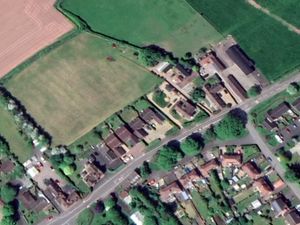
Through a gate and past the churchyard at Beckbury, near Shifnal, lies a secret slice of rural history – a glimpse of a time when cockfighting was considered a sport by the landed gentry.
Passers-by will probably have no idea of what sights assembled crowds would have witnessed but, just yards away from the public right of way and hidden from view by a large hedge, the circular structure is unmistakably a cockfighting pit – believed to be the only intact structure of its kind in Shropshire.
And it was in this arena that cocks fought, often for large sums of money and often to the death.
The pit is sited on private land but the Shropshire Star was granted a rare glimpse of this ancient sporting arena. Through an arched metal gate, the raised, purpose-built pit measuring around five yards in diameter, is located at the centre of a large amphitheatre with grassed banks all around.
"It is a complete amphitheatre," says historian Ron Miles from Jackfield, Ironbridge, "with a red sandstone plateau as a stage. People would have sat on the banks around the structure.
"On one side you the remains of an archway where the contestants would come in from both sides – the contestants would come in from each side, probably in their red or blue colours."
Cockfighting was banned outright in England and Wales in 1835.
A villager in his 70s, who asked not to be named, says: "My grandfather told me what used to happen – and after they banned cockfighting it carried on for a while. "What used to happen was they would have a look-out at four points in the village to see if anyone was coming, because the police were on horseback in those days.
"If they spotted police, the birds would be put away and the gentry would pretend that they were simply admiring the flowers there. During the war the Home Guard had an observation point up there."
The cock pit, built on land to the rear of Beckbury Church, is said to have been built in the early 1700s and is Grade II Listed, meaning it is nationally important and of special interest.
Dr Paul Stamper, from English Heritage, and formerly based in Shrewsbury, says: "I looked at the pit at Beckbury early in my career, 25 years or so ago.
"Across England there are 15 which are listed as being of historic interest. They all pre-date the middle of the 1800s when cockfighting was outlawed, and take various forms. Some are open around the 'dish' – Beckbury has got a wall round it – and some are roofed."
But Dr Stamper says it is tricky to establish precisely when the pit was constructed because such structures did not usually appear in official records of buildings.
According to English Heritage's National Heritage List For England, coops for rearing the birds survive at The Old Shop at Whitchurch.
Combatants, referred to as gamecocks, were specially-bred birds, conditioned for increased stamina and strength. The cockerel's trademark comb and wattle were cut off in order to meet show standards of the American Gamefowl Society and the Old English Game Club and to prevent freezing in colder climates.
Cocks possess an inbuilt aggression toward all males of the same species and will fight without provocation, but fighting cocks are given the best of care until near the age of two years old and are conditioned, much like professional athletes prior to events or shows.
In many other areas around the world, cockfighting is still practised as a mainstream event, and in some countries it is government controlled.
In his book, The Wandering Worfe, historian DH Robinson describes the scene at the Beckbury cock pit.
He writes: "On top of a plateau overlooking the church, is the pit – a circular enclosure about 50 yards in diameter. It is protected by a strong, tall fence and entrance is gained through a gated opening on the north side. In the very centre is a circular area raised three feet above the surrounding ground . . . it seems to be made of sandstone blocks. "On the southern perimeter are some sandstone steps leading to a small, underground chamber.
"Tradition has it that this enclosure, dating possibly from the 18th century, was used for the matching of gamecocks and the underground chamber was utilised as a store for the alcoholic beverages needed to encourage the onlookers."
And could it possibly be that the structure was built just a stone's throw from the picturesque village church for a reason? The author adds: "It was the general belief among the miners of the district that if the cock pit, wherever situated, was sprinkled on the morning of the affray with earth from the nearest churchyard, both spells and charms would be broken and 'the best bird would win'."
Although cockfighting is banned, the RSPCA says it still takes place today. Ian Briggs, chief inspector with the organisation's special operations unit, says: "In 2012 the activity still goes on. You still get people involved in cockfighting, and it is a clandestine and highly organised activity," he says.
The maximum penalty for cockfighting is 51 weeks' prison or a £5,000 fine.