The Race That Shocked The World - TV review
When, in the middle of the night, Ben Johnson learned he had been found to have taken illegal drugs, his response wasn't to panic.
When, in the middle of the night, Ben Johnson learned he had been found to have taken illegal drugs, his response wasn't to panic.
His pulse had barely slowed since he steamed to victory in the 1988 Olympic Games in Seoul when the knock on his door came.
"So," he told his coach Charlie Francis on learning the news. "They finally got me."
His fall from grace was instant. For 48 hours, Johnson's star had never shone brighter. As he basked in his triumph, he told a journalist: "The gold medal is something they can never take away from me."
It was a remarkable achievement by the makers of The Race That Shocked The World, on BBC4, to encourage Johnson himself to discuss his disgracing at the Seoul games.
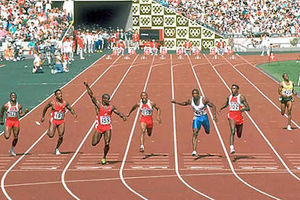
"That is the greatest 100 metres the world has ever seen," the commentator shouts as Johnson tears away from his competition, as the film launches with a shot of the Canadian star lifting himself – and the confidence of a nation – into the stratosphere.
Moments later, we are seeing him bundling his way through customs in disgrace, even the voices of the reporters at the scene dripping in fury as they demand answers. "Canada wants to know why!" one wails in raw, emotional fury.
Over the course of the hour-long documentary, we meet all the eight athletes who ran in the 100 metre final in Korea.
Each gives their own perspective on the race – which is presented as an emotionally charged centre point to the film – and on how widespread was the use of drugs in sport at the time.
The athletes are all captioned with their name, and the lane they ran in, in a nod to the all consuming nature of their work.
It is one of the many little details which really make the programme an excellent piece of work.
Johnson's interviews are conducted in his basement, the cold and rain penning the runner in, all alone to consider his disgrace.
He picks glumly through his medals, including the bronze he won at the 1984 Olympics in Los Angeles, detached from its ribbon and dumped unceremoniously among the rest.
He lost out in that race to Carl Lewis, a magnificent athlete who competed in four different medal events on the Olympic track – and won all four.
His 1984 gold lies beneath the ground, pressed into his father's palm when he died in 1987. Lewis vowed to win another the next year, driving home the consequences of Johnson's drug use on the other athletes.
The rivalry between the pair bubbled beneath the surface of the run-up to the Seoul games.
Starting with Lewis's dismissal of his Canadian opponent as 'lacking the core talent', it passed through Johnson's rising stock and Lewis's frustrations turning into a television appearance to discuss other athletes' drug usage, and it continues throughout the film.
One coach, Russ Rogers, suspected 80 per cent of athletes were using drugs at the time. Francis too suggests that the ability to stay ahead of chemical enhancements runs out.
The film is beautifully shot, tells the story of the whole drug issue at the time, and is full of quirks.
While it centres on Johnson's own personal scandal, it becomes a tale of rivalries rising and simmering over the course of decades, of drug use and obsession.
And at its heart is the pulsating 10 seconds where the eyes of the world are on eight lanes in a single stadium.
Considered, heartfelt, and showing the fine line between triumph and disaster, it presents as perfect a summary of what it is to be an Olympian as you could imagine.
Thom Kennedy