Anglo-Saxon splendour returns to Soulton’s Great Hall as celebrated research team reunites
At a mid-winter feast on January 31, the Thegns of Mercia and the Ashton family celebrated a milestone in English heritage at Soulton Hall. The evening highlighted transformative discoveries linking the Anglo-Saxon and Tudor eras, most notably the identification of the "Garnet Code" and the discovery of St Erkenwald’s lost relics.
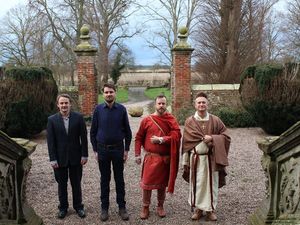
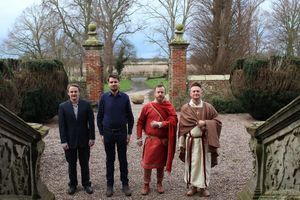
The team of four pictured here in Soulton’s Chess Court, Aed Thompson, James Syrett, James D. Wenn and Tim Ashton are responsible for an important series of discoveries that all link back to a special stone. Anglo-Saxon (early medieval) jewellery was dominated by one particular gemstone: the garnet. No-one knew why till Thegns of Mercia member Mr Wenn and associate Mr Syrett brought their historical and scientific knowledge together and made the breakthrough that the stone’s natural shape — the rhombic dodecahedron — was the fascination that made our forebears treasure this material.
Thegns of Mercia is a world-leading historic research and educational living history group chaired by Aed Thompson. Mr Thompson is an expert on material culture from the fifth to eighth-century CE period that is the focus of the group, with encyclopaedic knowledge honed by the intensity of study required for producing museum-quality replicas of archaeological finds. It was Thompson’s keen eye that tracked down the garnet’s huge impact on whole fashions of medieval textiles and metal jewellery — along with coins, and sacred objects like the bronze rhombic-dodecahedral finials believed to have been holy water sprinklers used by Christian priests. “Even in the 8th century when direct use of garnets became rarer” Thompson added “Anglo-Saxon craftspeople made metal objects to represent their associated shapes”.
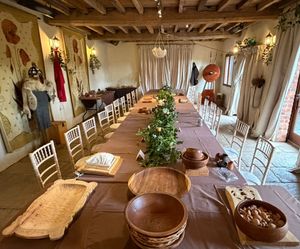
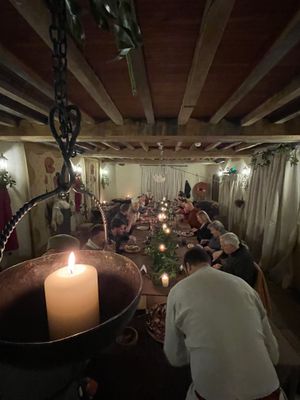
The Thegns were at Soulton for a grand feast on January 31, marking 14 years of their educational work, and coming together as a team to celebrate the winter months in traditional ‘Yule’ fashion with friends of the group including artists, historians and archaeologists from across the UK. There was also a chance to reminisce about ‘Beowulf at the Barrow’, a fondly remembered public event by the Thegns at Soulton back in 2021, when Mr Wenn first saw Soulton and met Mr Ashton, the incumbent at Soulton Hall. That opened up the research into the life of the ‘garnet code’ beyond the middle ages through the Tudors and beyond. Many of their research discoveries have been reported in the Shropshire Star.
Syrett said, “without each of our backgrounds — frankly, strange talents — expertise and resources, we would never have travelled as far as we have. A great example is the Coronation Pavement in Westminster Abbey. I found how its plan is what you put on faces of a cube to help you ‘carve out’ a rhombic dodecahedron or garnet — the 3D special shape — but it was James (Wenn) who realised the four hexagons in the pavement did the same carving trick through another shape, the octahedron, proving that this is what it is all about. This clinched it, but our socks were knocked off by Aed, who found that the dimensions of the pavement perfectly matched the Mercian royal crypt at Repton, Derbyshire.”
Ashton added, “working with the others over the past few years we could piece together how important the Anglo-Saxon and coronation mysteries were to our ancestors… and still can be. It is breathtaking to see a character like the Tudor-period Old Sir Rowland Hill preserving these memories, but to be part of the present day survival of a whole culture is humbling.”
One further headline-grabbing discovery unlocked by this new ability to ‘read’ the symbols is locating the lost relics of the Patron Saint of London, a seventh-century bishop called Erkenwald, within the grounds at Soulton Hall. Wenn said “it is really special to come back as part of the Thegns of Mercia to the ancient Saxon manor of Soulton, where so much of our latest research was incubated from 2021, now knowing that a seventh-century priest — a real titan of our period — was honoured and remembered here in the Tudor era”.
These discoveries were discussed with visiting academics at the Thegns of Mercia hosted feast which also saw performances of Old English poetry and music with replica instruments, and the unveiling of new recreations of archaeological finds.
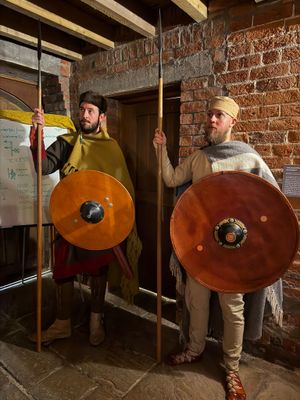
The group's Chair reflected, after the closure of formal proceedings, “With diverse influences and vibrant cultures, which laid the foundations for so much of our modern world, the ‘Anglo-Saxon’ period is pivotally important to our history and has so much potential to inspire and unite. Unfortunately few buildings survive so there are a lack of heritage sites at which people can experience and learn about this period, which is why creative use of anachronistic but atmospheric and historic settings is essential for making this heritage accessible. From the great-hall complex / palace at Atcham, to Wenlock Priory, Shropshire has so much early medieval heritage to celebrate, and we're proud to be able to add Soulton Hall to that auspicious list of nationally important sites. We're immensely grateful to the Ashton family for enabling us to create an Anglo-Saxon feast hall for our team, and honoured guests, in which we are able to mark a milestone year for the group.”
He continued, “This evening represented an opportunity to bring the past to life and to bring forth a sense of community, which is increasingly important against the backdrop of persistent heritage cutbacks. This feast represented a private celebration of the growth of our group since its founding, in the wake of the discovery of the Staffordshire Hoard, and an opportunity to share and celebrate the notable discoveries made at Soulton with the team, friends, and learned colleagues from academic and creative communities.”
The glittering feast at Soulton was a private event, but both the Thegns and the Ashtons are planning what forthcoming and future public events can bring the Thegns’ Anglo-Saxon magic to Shropshire!