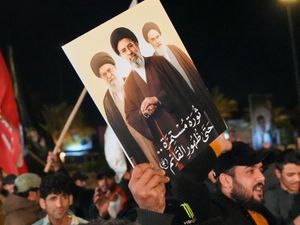
Iran launches new attacks as US warns of ‘most intense day of strikes’
Iran has also been targeting energy infrastructure which, combined with its stranglehold on the Strait of Hormuz, sent oil prices soaring.
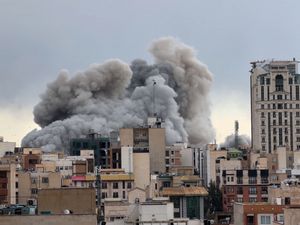
Iran has launched new attacks at Israel and Gulf Arab countries as it kept up pressure on the Middle East in a war started by Israel and the United States that has rattled world markets and shows no signs of a let-up.
In Bahrain, authorities said an Iranian attack hit a residential building in the capital Manama, killing a 29-year-old woman and wounding eight people.
Saudi Arabia said it destroyed two drones over its oil-rich eastern region and Kuwait’s National Guard said it shot down six drones.
In the United Arab Emirates, firefighters battled a blaze in the industrial city of Ruwais – home to petrochemical plants – after an Iranian drone strike.
No injuries were reported.
Sirens also sounded in Jerusalem, and sounds of explosions could be heard in Tel Aviv as Israel’s defence systems worked to intercept barrages from Iran.
At the Pentagon, US defence secretary Pete Hegseth warned that Tuesday “will be yet again our most intense day of strikes inside Iran: the most fighters, the most bombers, the most strikes, intelligence more refined and better than ever”.
Shortly before the statement, he said “the last 24 hours have seen Iran fire the lowest amount of missiles they have fired yet”.
General Dan Caine, chairman of the Joint Chiefs of Staff, said US forces hit more than 5,000 targets, and that their three objectives included destruction of Iranian ballistic missile and drone capability; hitting Iran’s navy to allow movement through the Strait of Hormuz; and hitting “deeper into Iran’s military and industrial base”.
The rhetoric was equally sharp from Tehran.
Iran’s parliament speaker, Mohammad Bagher Qalibaf, said on X that Iran was “definitely not looking for a ceasefire”.

“We believe that the aggressor should be punched in the mouth so that he learns a lesson so that he will never think of attacking our beloved Iran again,” he said.
Another top Iranian security official, Ali Larijani, appeared to threaten US President Donald Trump himself, writing on X that “Iran doesn’t fear your empty threats. Even those bigger than you couldn’t eliminate Iran. Be careful not to get eliminated yourself.”
Iran has been accused of plotting attempts to kill Mr Trump in the past.
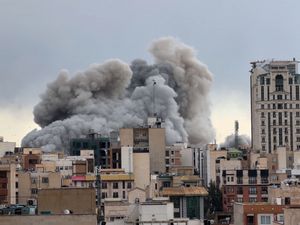
Witnesses reported hearing several explosions in Tehran in the afternoon as Israel commenced a new wave of air strikes.
Along with firing missiles and drones at Israel and at American bases in the region, Iran has also been targeting energy infrastructure which, combined with its stranglehold on the Strait of Hormuz, sent oil prices soaring.
Brent crude, the international standard, spiked to nearly 120 dollars on Monday before falling back but was still at around 90 dollars a barrel on Tuesday, nearly 24% higher than when the war started on February 28.
Mr Trump, who has previously said that the war could last for a month or longer, sought to downplay growing fears that it could take even longer, saying it was “going to be a short-term excursion”.
Still, Israeli Prime Minister Benjamin Netanyahu vowed the strikes on Iran would continue.
“Our aim is to bring the Iranian people to cast off the yoke of tyranny, (but) ultimately it depends on them,” Mr Netanyahu said during a meeting with Israel’s hospital and health system leaders. “There is no doubt that with the actions taken so far, we are breaking their bones.”

The war has choked off major supplies of oil and gas to world markets and sent fuel prices rising. The fighting has also led foreigners to flee from business hubs and prompted millions to seek shelter as bombs hit military bases, government buildings, oil and water installations, hotels and at least one school.
Iran has effectively stopped tankers from using the Strait of Hormuz, the shipping lane between the Persian Gulf and the Gulf of Oman — the gateway to the Indian Ocean — through which 20% of the world’s oil is carried.
Attacks on merchant ships near the strait have killed at least seven sailors, according to the International Maritime Organisation.
In a post on social media, Mr Trump seemed not to acknowledge that, saying that: “If Iran does anything that stops the flow of Oil within the Strait of Hormuz, they will be hit by the United States of America TWENTY TIMES HARDER than they have been hit thus far.”
Amin Nasser, the president and CEO of Saudi Arabia’s oil giant Aramco, said tankers were being rerouted to avoid the Strait of Hormuz, and that its East-West pipeline would reach its full capacity of seven million barrels a day being brought to Red Sea ports this week.
“The situation at the Strait of Hormuz is blocking sizeable volumes of oil from the whole region,” he said in a conference call after Aramco, formally known as the Saudi Arabian Oil Co., reported 2025 profits of 104 billion dollars, down from 110 billion in 2024.
He also hinted at global oil markets being squeezed the longer the Iran war goes on and shipments from the Middle East remain affected.
“Given the current geopolitical situation, we may see inventories eroding and being drawn down faster as shipments are being curtailed from the region,” he said. “This is at a time when current global spare capacity remains extremely low.”
If supply grows tighter, it would likely push the price per barrel globally even higher, translating to higher costs for gasoline and jet fuel.
Five members of the Iranian women’s soccer team who were in Australia for a tournament when the Iran war began were granted asylum, home affairs minister Tony Burke told reporters in Brisbane.
The team drew widespread news coverage in Australia when players did not sing the Iranian anthem before their first match. The 26 players had arrived for the Women’s Asian Cup last month, before the war started. They were knocked out over the weekend, raising prospect of having to return home to a country under attack.
Mr Burke, who posted photos on social media of the women smiling and clapping as he signed documents, said all players on the squad had been offered asylum.
It was not clear if or when the other 21 players would return to Iran.
As the conflict spread across the region, Israel launched multiple attacks on the militant Hezbollah group in Lebanon, which responded by firing missiles into Israel.
Pro-Iran militias in Iraq have also launched attacks at US bases in the country since the beginning of the conflict.

Early on Tuesday, one such militia – the 40th Brigade of the Popular Mobilisation Forces in the city of Kirkuk – was hit with an air strike that killed at least five militiamen and wounded four, according to officials.
It was not immediately clear who was behind the strikes.
Israel’s military meanwhile reiterated a call for all residents of southern Lebanon to evacuate their homes, saying it planned to “operate forcefully” there against Hezbollah.
Since the war began, at least 1,230 people have been killed in Iran, at least 397 in Lebanon and 11 in Israel, according to officials.
A total of seven US service members have been killed.