‘Simple’ colour card for describing bodily fluids could improve patient outcomes
The colour of bodily fluids can play a key role in diagnosing, investigating and prescribing for a wide range of medical conditions.
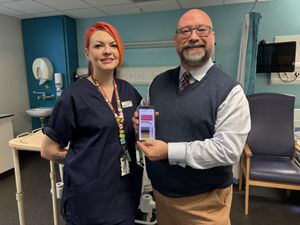
A “really simple” tool that makes it easier for people to describe the colour of bodily fluids could have a “huge impact” on patient care, researchers have announced.
A team at Edinburgh Napier University has developed a standardised colour palette that can be used by patients and clinicians when describing the colour of fluids like urine and sputum.
This information can play a key role in diagnosing, investigating and prescribing for a wide range of medical conditions.
The free online tool, called What Colour Is It?, resembles a paint colour card, with palettes of either 13 or 15 clinically-relevant colours for identifying the colour of sputum, urine and faeces.
Each colour on the palette has a unique “hex code” – an international code for colour identification – that can be entered into a patient’s notes, which other clinicians can then use to find the exact colour being referred to by the patient.
The researchers said by reducing the level of subjectivity when describing different colours, the tool can help make diagnosis faster and more accurate, and so help improve patient outcomes.
They also said having a chart to refer to can reduce the embarrassment that can make it difficult for patients to discuss bodily fluids with clinicians.
Hazel McPhillips, an advanced nurse practitioner and a lecturer at Napier, said: “We rely on our patients describing a colour and us assuming that we’re thinking the same colour.

“We prescribe, we diagnose, we investigate based on the description of that colour, and that’s really subjective.
“In our documentation we then write, ‘the patient says it’s greeny-brown or bluey-black’, or whatever colour it’s described as, and the next person may have another interpretation of that colour in their head.
“This toolkit really standardises that. It takes the subjectivity out of it and makes sure everyone’s working from the same colour.”
She went on to describe the impact this could have on patient outcomes.
“We know in clinical practice that whenever we look at accidents, there are investigations, there are issues, it’s usually down to poor documentation or poor communication.
“Almost every fatal accident inquiry you ever look at ends with, ‘communication could have been better, documentation could have been better’.
“This is a very small thing, but if we can standardise that small part, that could have a huge impact on patient care and actually on safety as well.”

The team said the tool could help communicate accurately during remote appointments, such as over NHS24 or when dialling 111.
They said a visual chart can also help overcome communication barriers due to factors like language, age, and certain medical conditions, which can make it difficult for patients to describe colours verbally.
Business improvement consultant Stephen Yorkstone explained: “There are so many reasons that it’s helpful to use.
“Kids, for example, might not have the same words for colours that we do, (likewise) people from different parts of the world, or with different language abilities.
“But also we know of one nurse who’s using it with stroke patients who have something called aphasia, which means they can see, they can understand, they can think just fine, but getting words out is really hard.
“But this means that for them, a conversation that would be a struggle becomes much more seamless and much more easy.”
Mr Yorkstone added that the “simplicity” of the tool is key to its effectiveness.
“It’s a dead simple website that you can load on your phone, because clinical folk use their phones all the time nowadays, and you just click a button and it opens a colour scale,” he explained.
“You can pull it out of your pocket, point at a colour so that you can communicate about colours more clearly clinically.”
The team launched the tool four weeks ago and, so far, it is being used by about 225 people in a number of countries, in medical specialisms as wide-ranging as nursing, physiotherapy and dentistry.
Mr Yorkstone said: “We know they’re using it for about a minute at a time and, actually, it takes less than a minute to open it, point at the colour with the patient and do that.
“So, we’re pretty confident that it’s starting to be used.
“And we’ve got users from across the UK, America, Norway, Sweden and Australia already.”
The team said they hope the tool will become “a normal part of our healthcare system” used by all professions across all healthcare fields.
Ms McPhillips said: “It’s going to make so many things so much safer and much more simple for patients as well as staff.”
The What Colour Is It tool can be found at blogs.napier.ac.uk/wcii.