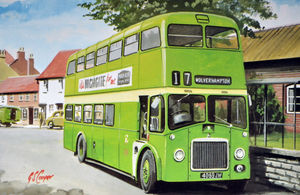
Memories of the old Severn Valley Railway and motorists are fed up! Your letters - plus an old postcard of the number 17 to Wolverhampton stopping at Bridgnorth
Here's your latest letters - plus our daily delve into the picture archive.
More details on SVR signal box
After my 55 years with the Severn Valley Railway the publication in the Express & Star of the previously unknown 1908 photograph literally blew me away, such that I could not wait to write back in gratitude.
Unfortunately in my anxiety to catch the post I omitted essential information which I had meaning to include, so that the letter implied that the signal box existed solely to handle the farm produce.
It did not. The box was there to operate the branch to Kinlet Colliery, the line to which was the continuation of the long approach track mentioned in the previous letter which continued in front of the box, then, out of site for about 50 yards, before turning left round a 90 degree curve and roughly following the course of the Borle Brook up to the colliery.
The line was two-way and operated in what was known as the “one engine in steam” system. The work required from the signalman to do this was very light, only having to operate the points to allow access for empties to arrive and loads to deport plus a couple of signals in each direction of the branch.
The farm traffic was of a very secondary nature but the railway company must have decided that the additional income was worthwhile pursuing and it was this that determined the actual sitting of the box. The topography dictated this so that access could only be made from the main line by means of a facing punt in the direction of Kidderminster.
This made the delivery of empties very simple but the dispatch of loads very difficult due to the minimal space available for the track arrangements and the number of shunting movements required.¶From the size of the box it appears that all movements were controlled from it, making about five times as much work for the bobby to deal with a farm produce train as it did for a coal train.
Trevor Matthews, Claverley
I need to park on pavement
Plans to ban pavement parking do not take myself into account people like myself who live in a narrow road. We have to park our cars on the path so vehicles can get past, and I always leave a good gap on the path for people.
A hope this clears up a few points about car parking.
Paul Bullows, Sedgley
Dazzling lights are a menace
As one who has driven all kinds of vehicles from motorbikes, cars and HGVs for over 60 years, I, like many others, am encountering over bright dazzling lights from oncoming vehicles at night, as well as from some cyclists with head mounted LED lamps. The answer, until legalisation is altered, to ban offending lights, is to look to the left hand verge momentarily and never look directly at the dazzling lights.
W F Kerswell, Picklescott