Equality fight goes on for our female MPs
Exactly 100 years ago, women were allowed to vote in a general election for the first time – but does that mean genuine parity has been achieved?
It was probably not uppermost in Theresa May's mind as she addressed the nation from outside Downing Street.
But having survived a bruising few hours in which her authority was challenged like never before, the embattled Prime Minister will probably at some stage today reflect on the much tougher battles endured by her forebears.
It is 100 years today since the first election in which women were allowed to both vote and stand for office.
Not all women could vote; they still had to be aged 30 or over, and meet property ownership requirements, but nevertheless it represented a huge stride in the march to equality. And it is unlikely that many of the women who turned out to vote in 1918 would have envisaged the scenes of this week, when MPs of both sexes took part in a vote on an equal footing to determine whether Britain's second female prime minister should continue in her role.
As recently as 1973, then education secretary Margaret Thatcher, who went on to blaze a trail as the UK's first female PM, famously told children's television programme Val Meets the VIPs that she did not expect to see a woman premier in her lifetime.
Today there are a record number of 208 female MPs in parliament, with six of them sitting in Cabinet.
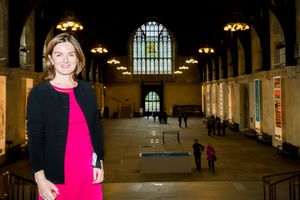
Among them is Lucy Allan, who in 2015 became both the first female MP and the first Conservative MP to represent Telford constituency.
As the great niece of militant suffragette Janie Allan, who spent four months in Holloway Prison in the battle to get women the vote, she does not have to look far for a role model in her family.
Ms Allan says the political world has changed enormously since her great aunt took to the streets in 1912, joining 100 other for a window-smashing protest in central London.
“It’s hard for us today to imagine women not having an equal say in our democracy," she says.
“We have come a long way, but there is still more to do.
"For example, in society, we still see disparities in gender pay in many of our public institutions, and imbalances in our education system, in business, and in the media.
“Politically, too, we must continue to remove barriers to entry and present an environment that is welcoming and respectful to all.”
"We owe Janie and her fellow campaigners a huge debt of gratitude for their persistence and determination."
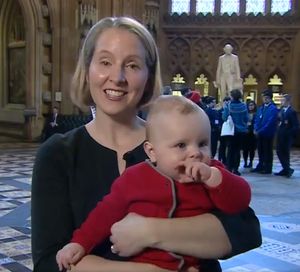
Emma Reynolds has been the Labour MP for Wolverhampton North East since 2010. Born less than two years before Margaret Thatcher took office in 1979, she has grown up in an era where it has become increasingly normal for women to take frontline roles in politics. But she says there is still a lot of work to be done for genuine equality to be achieved.
As we speak, she is travelling back to her constituency with her son Theo, who was born just four days before Theresa May called a snap general election last year. She says the challenges of juggling motherhood with a career in politics are still very challenging.
"The Houses of Parliament are set up for men whose wives stay in their constituencies with the children," she says.
"That sounds like a stark generalisation, but that's what has happened for decades, and it is only now that we're starting to get away from it."
Miss Reynolds says there have been improvements in the eight years she has been in parliament – at the moment there are calls for proxy voting, so that MPs who are on maternity leave are not expected to turn up to vote, or rely on pairing arrangements with opposing MPs.
Her seat has a long tradition of high profile MPs. From 1964 until 1987 it was held by the formidable Labour MP Renee Short, and after she stood down the seat was taken by Conservative Maureen Hicks.
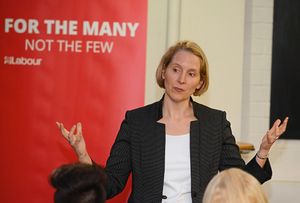
"It changed a lot in 1997, when Blair came in and we had a significant number of women come into Parliament, but we are still outnumbered 2-1 by men," says Miss Reynolds.
On the positive side, she says there are a growing number of younger female MPs in parliament, which is helping to change the culture.
"When I became an MP I was 32, and there are more women with children in parliament, which is good. We have also got a number of women ministers and women chairing committees.
"More women are giving birth while they are in parliament – I'm expecting again, myself – and it is important that Parliament is able to reflect this."
Perhaps unsurprisingly, as a Labour MP, she has mixed views on the role Mrs Thatcher played in making politics more accessible to women.
"I can't remember a policy which Thatcher enacted which did much for women, I would say Harriet Harman was the woman who did much more," she says.
"On the other hand, having a female prime minister is a role model, and there are many countries which have never had a female prime minister."