Shropshire Star

Shropshire retro: 27 pictures that take you straight back to 1958

Here we present a fascinating mix of images from the Shropshire Star archives from 1958.

Plus
Published
Last updated

From aerial shots and street scenes to everyday faces, and even an unidentified inmate playing the blues behind bars. We hope you enjoy this eclectic collection.

You can enjoy this and more with our weekly FREE Nostalgia Newsletter - with scores of archive pictures and exclusive features on the history of Shropshire and Mid Wales - all sent to your inbox every Friday. Sign up here
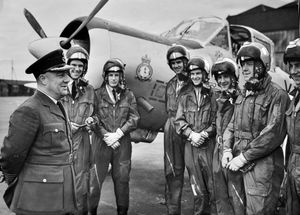
May 19, 1958, the caption reads: 'Group Captain B.R. Beare has recently become station commander at RAF Tern Hill, which has been training pilots since 1916. Altogether, 3,200 pilots have passed through the gates. Group Captain Beare was the first pupil pilot to be trained in January 1936, when the station was reopened. He is pictured here with trainee pilots.'
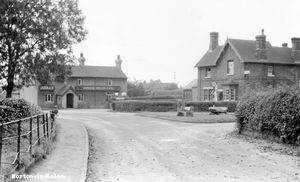
Norton-in-Hales village. This picture was shared by David Francis, who said: 'Postcard photograph, circa 1958, of Norton in Hales showing the Hinds Head Inn, shop, post office and garage workshop attached. The shop and garage, owned at one time by Bill Marshall, shows a petrol pump and a Cleveland petrol sign. By the road sign the Bradling stone can be seen. This was a glacial deposit from the Ice Age known as an erratic. Legend has it that if anyone was found working after midday on Shrove Tuesday they would be taken to the Bradling stone and either beaten, bumped or rolled on the stone or bradled. The word 'bradled' is mentioned in Wright's Dialect Dictionary of 1898 as meaning 'beat'. Another school of thought is that the stone marked a Parish boundary and on the occasion of Beating The Bounds younger members of the community would be 'bumped' on the stone so that they would remember the Parish boundary. I wonder if the little boy on the left of the picture is waiting for his father to come out of the pub!'
Pupils at The Grove School, Market Drayton, late 1957 or early 1958. The picture comes from Adrian Darrant, who was among the first pupils at the brand new school building when it opened in September 1957, and was only there for two terms while his father was based at RAF Tern Hill. He is front, middle, and does not know any of the others. He says it was taken on the school fields.
Pupils at The Grove School, Market Drayton, late 1957 or early 1958. The picture came from Adrian Darrant, who was among the first pupils at the brand new school building when it opened in September 1957, and was only there for two terms while his father was based at RAF Tern Hill. He is front, middle, and could not name any of the others. He said it was taken on the school fields.
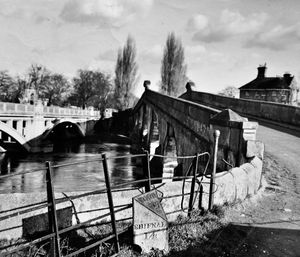
A February 1958 Atcham bridge picture. The old bridge is on the right, the 20th century bridge is on the left. The caption pasted on the back was about Shrewsbury market, so presumably the Atcham milestone was the connection or intended feature, even though we are looking away from Shrewsbury. (The caption read: 'Tuesday is a busy day in Shrewsbury. Farmers come from all over Shropshire to buy and sell cattle or for a day out and a friendly chat. The centre of Shrewsbury will soon lose this age old custom, for the market will shortly be transferred to Harlescott on the outskirts.' The date stamp on the print is February 18, 1958, which will be when taken, and the stamp by the caption is February 19, 1958, no doubt the publication date.
A February 1958 Atcham bridge picture. The old bridge is on the right, the 20th century bridge is on the left.
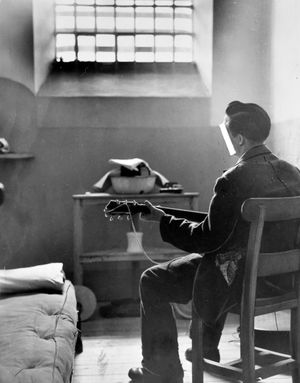
A prison cell at Shrewsbury jail (Dana Prison) in June 1958. The caption reads: 'Playing the blues - in a prison cell.' This unusual picture was taken by Express and Star chief photographer Bert Johnson.
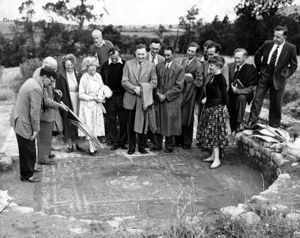
Yarchester Roman site near Much Wenlock, July 29, 1958: Part of the caption is missing, but we can make out the following: 'Shropshire summer school for secondary modern teachers, which is being held at Shrewsbury, visited the Roman villa at Yarchester yesterday. Mr J. Corbett (left)...(about three words missing) class, is history master at Much Wenlock secondary modern school.'
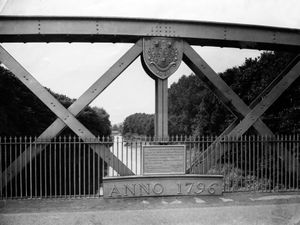
Buildwas Bridge in 1958. The caption reads: 'This structure spanning the River Severn at Ironbridge is known in the district as the 'Wenlock Bridge.' It was erected in 1905-1906 to replace Telford's first cast iron bridge, built in 1796. The underlying casting is a portion of the old bridge.'
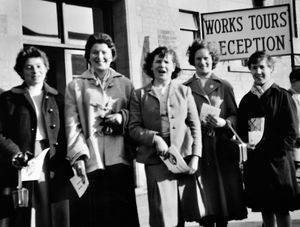
'Hodnet YFC annual trip to BMC, Cowley, April 1, 1958.' This picture was shared by Mr Neville Edwards. He was chairman of Hodnet young farmers and names these as, from left, Liz Bebbington, of High Hatton, her sister Marion Bebbington, from High Hatton, Liz Walley, from Stoke-on-Tern, Mr Edwards' sister Barbara Edwards from Wem, and on the right, Ruth Chidlow, a cousin of Mr Edwards. Mr Edwards was brought up in Wem and in 1953-54 was a student at Shropshire Farm Institute, at Walford (later called Walford Farm Institute/Walford College). He started at the institute on September 28, 1953. Ultimately he worked in sales for Fullwoods of Ellesmere.