How a ground-breaking programme in Shropshire has helped to save the lives of men facing prostate cancer
Working diligently for the health of men across the county, Whitchurch Rotary Club is about to complete a decade of annual prostate cancer tests – a ground-breaking project that now claims a place as one of Rotary’s largest UK community health projects.
The PSA screening programme, for early detection of a disease that kills more than 12,000 men every year, is provided free of charge with costs covered by Rotary fundraising projects and public donations.
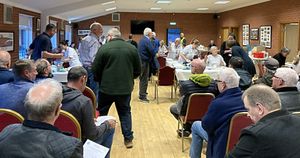
At last year’s event a record 953 men were tested locally, in four hours, by a team of professional phlebotomists with administrative support from Rotarians, Inner Wheel members, friends and supporters.
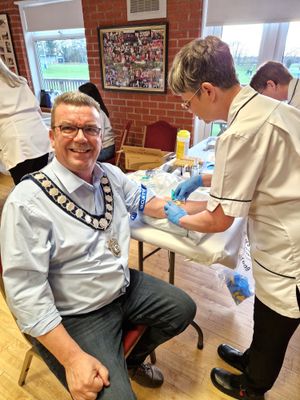
This year’s event is planned for Monday, October 6, at Whitchurch Rugby Club from 6pm.
“We now have massive queues, even in the pouring rain,” said Rotarian Graham King. "King Charles’ diagnosis has raised the profile of cancer, and we are now seeing a lot more people taking it very seriously.
“There’s also a great sense of solidarity between everyone we get standing in line. It’s a ‘we’re all in this together’ type of atmosphere.”
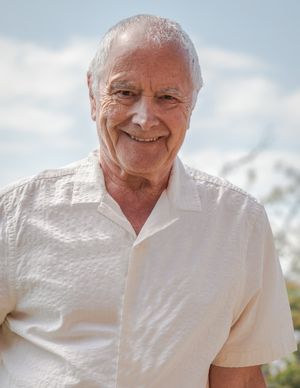
The man who started it all in Whitchurch is Dave Simcock, a past president of Whitchurch Rotary which he joined 13 years ago. Dave, aged 80, and married for 55 years with two daughters and four grandchildren, bought and managed his own baking and confectionery business in Whitchurch for many years before training as a teacher.
After gaining a diploma in Management Studies he went on to teach and assess staff for companies up and down the country, and he has served as a Whitchurch town councillor including two years as mayor.
After his own experience with prostate cancer Dave, with the support of his Rotary colleagues, launched the annual testing initiative in 2015.
It has now become one of the main things Whitchurch Rotary is known for in and around the north Shropshire town.
Dave is so closely associated with the prostate project that, last December, the community voted him ‘Citizen of the Year’.
Here, the man who started the Whitchurch programme tells how his own prostate experience launched a vision that has saved countless lives. This is Dave’s story.
Me and my cancer
Little did I ever imagine how a routine six-monthly visit to the doctor, to check my colitis condition, would not only save my life but turn the world upside down for my entire family.
I had retired from work at Christmas in 2010 and was slowly getting used to not having to be in certain places at certain times. I was getting jobs done that had been waiting a while. And I was enjoying my new freedom to play bowls. The summer was ahead of me.
After the doctor had completed those routine checks, I was about to leave the surgery when she suddenly added: “I see you haven’t had a blood test lately. I think you should. So, let’s check that everything else is working normally.”
So, I was booked in, for the next day, to have my sample taken. And with that done, I didn’t give it another thought. Until three days later.
That was when I had a call from the surgery saying that the doctor would like to discuss some of the blood test results.
At the time I simply expected to be put on new tablets for something or other. But everything changed when she declared that ‘most’ things were fine... but she wanted further tests regarding my PSA result.
So, what’s a PSA, I asked?
That’s an abbreviation for Prostate Specific Antigens – and mine, she said, were raised. My total ignorance deepened – so what is my prostate?
The doctor went on to explain. And it was at this point that, for the first time, she used the word ‘cancer’. We looked at each other for a few seconds. I said I felt fine... so what do I do now?
She said: “Nothing – but I want you to have another test in six weeks.” So, my follow-up test was scheduled. Even then I was thinking that someone must have got something wrong. Again, I put it out of my mind.
I had the next blood test six weeks later, as arranged, only to receive another phone call for another visit. This time the conversation was totally different. And the tone became far more serious.
“I would like you see an oncologist,” she said. “In fact, I have booked you an appointment for next week because your PSA reading has gone up from four to seven – within six weeks. So, I advise you to go and see him,” – which I did.
He arranged for me to have a prostate biopsy.
Just over two weeks later I went back to the hospital... to be told I had stage-four malignant neoplasm prostate cancer.
In the short term I was put on drugs pending a further discussion with the oncologist. And, again, my obvious naivety must have shown because I could not get my head around having cancer. To me that was not possible. So much so that I didn’t even tell my wife, who was on holiday with friends in France.
That same evening, however, I was given a lift to a bowls match in Market Drayton and the person who was driving asked what I had been up to. My reply was quite frank: “I was told I have cancer today.”
He nearly drove the car off the road. The vehicle swayed. I laughed. They went white. I was still smiling because it had still not hit me yet.
For days I mulled it over... and over. Again... and again.
It wasn’t until I again saw Mr Lynn, my oncologist, that he told me in no uncertain terms that we were on a timescale to save my life.
He gave me three options to choose: chemotherapy, hormone treatment, or removal. It took me seconds to reply: “Just get rid of it... as soon as possible.”
A couple of weeks passed and I heard nothing. Then, on January 22, 2012, he phoned me to say that if surgery was still my decision, he had a cancellation for January 24. I took it.
The operation went ahead with as much of my dignity as they could preserve.
And, after all the drugs that kept my spirits high had worn off, came the sadness and the tears. Not to mention the pain of having the 36 clips removed that were holding my stomach together.
After that was just a matter of repair and gaining strength to move forward. That took me around nine months. I seemed to be coping well – given that my whole prostate had been removed and other things were happening as a result. Learning to control my bladder, for one thing. And the basic indignity of having to wear a nappy until the repair work had settled down.
Sitting around had never been my way. And if my body was not ready to get stuck in, my brain certainly was. So, later in the year, when things had picked up, I started to think of things to do.
One of them was to visit my brother in New Zealand – so we planned, with a friend and his wife, to take the plunge and go. It was the incentive I needed to spring back into the way I had always treated life.
After returning from the trip, I couldn’t wait to get back involved with the many activities that Whitchurch Rotary offered. This didn’t take long. Anything going, I was there. Darts, croquet, bowls, quizzes, and ten pin bowling... Rotary includes meeting up with people and enjoying the social side of membership.
In the process, you get to talk to different people, from other clubs, and I was amazed how many people mentioned the word ‘cancer’.
That was when I wondered whether I could do something to help men who find themselves in the same position that I had experienced now nearly three years before.
I made a plan and asked my club what support I was likely to get if I went down the road of organising a mass public prostate testing project. Would they back me? You bet they did.
Cancer is a word that spreads fear into individuals and families. And if we don’t tackle it head on, it will beat us every time.
My story is that I’ve been very lucky. I’ve had 14 years or so of extra life that I certainly would not have otherwise had. And I have an injection once every 12 weeks to keep the antibodies at bay.
All this happened because a doctor gave me a blood test, just by chance, and every day I think how lucky I have been. I’m now waiting for that luck to rub off on me again... which is why I do the lottery every week.
With one in eight UK men being diagnosed with prostate cancer at some point during their lifetime, the incredible work of Dave, Graham and their fellow Rotarians is more important than ever.
“We’re very proud to be known for this work,” said Graham. “The community respects it, and it is very, very rewarding to be able to help people in this way.”
The whole team at Whitchurch Rotary are hopeful that more and more men will continue to come forward, and with stark but hopeful sentiment, would encourage as many as possible to do so.
“Men should come and get tested because, sadly, prostate cancer can happen to anybody,” said Graham. “But most importantly, detecting it early can save your life.”
Visit whitchurchrotary.org.uk/services/prostate-testing to learn more.