Accomplished pilot, amateur engineer, world record breaker, jazz musician, and influential and innovative teacher of helicopter crews...
Varied career of Shropshire pilot and innovative instructor Ray Lawrence MBE who saved over 100 lives and taught many of today's RAF top brass
But not quite so hot at maths, where he claimed to have scored just two per cent in his schooldays General Schools Certificate exam.
Lack of academic prowess proved no handicap to the distinguished and varied RAF career of Shropshire's Flight Lieutenant Ray Lawrence, who would save over 100 lives along the way.
His legacy remains today, with many of the people he trained to fly now populating the RAF's senior hierarchy, and some of his teaching practices are still put forward as the best way to deliver complex subjects to students.
As a pilot, he was 38 years in the cockpit. His fighter pilot years saw him posted across the UK but his helicopter period was concentrated mostly at RAF Tern Hill and RAF Shawbury.
On retirement in 1988 he and wife Sheila lived on the doorstep of the Tern Hill base and Ray used to listen and wave to the helicopters from Shawbury and Tern Hill as they flew over, reminding him of his life in the RAF.
Ray, who has died aged 92, was awarded the MBE in 1981 for his outstanding contribution to the instruction of helicopter pilots and crewman students, receiving the medal personally from the Queen.
It was, he would say, "Not bad for someone who 'should become a reliable artisan'" - that comment had come in a 1949 reference - and who had left school with no qualifications.
"Ray was an old school RAF officer and pilot, who put service before self and delivered exceptional results across his entire career," said his sons David and Matthew.
Matthew was inspired himself to join the RAF, flying as a navigator of a Tornado jet for over 30 years, and is now base commander at the RAF's electronic warfare range in Cumbia where he uses his father's method of supporting and motivating his team.
Hailing originally from Willesden, north London, during the Blitz Ray and his brother Gerald would go out with a cart after the all clear to collect pieces of shrapnel or bomb casings as souvenirs.
In 1951 he was called up for National Service and chose the RAF. At some point an officer said: "Anyone who has their School Certificate want to try to be a pilot? Follow me." Ray seized the chance, and on being asked if he had the certificate responded: "Well, I was educated up to the standard but never sat the exam." That got him into pilot and officer training at RAF Cranwell.
David and Matthew said: "Ray was an almost unique pilot in Royal Air Force service in that he started his RAF pilot career flying jet fighters, the Meteor and Hunter, but his interest in aviation and engineering drove him into a career change and he transitioned to flying helicopters – an exceptionally unusual career move when most pilots wanted to fly supersonic fighter aircraft."
Helicopter career highlights included Ray being part of a team that in 1963 set a new world record for the longest helicopter flight ever made by helicopters by any air force. The Bristol Belvedere flew from Odiham in Hampshire to RAF Khormaksar, Aden, the journey taking in France, Italy, Greece, Crete, Libya, Sudan and Eritrea.
Also in 1963 he flew combat support sorties from RMAF Kuching during the Indonesia-Malaysia or Borneo confrontation, an undeclared war. He flew the heavy lift Belvedere supporting the British Army, including Gurka units, and his primary role was moving men and equipment in the jungles of Borneo and resupplying them.
One sortie saw him land in a jungle clearing to drop off an army patrol and the helicopter came under mortar fire. He was to have a close call, looking down through the glass cockpit floor and seeing below an 81mm mortar bomb which, luckily, had not gone off.
The family still have a presentation kukri presented to him for his support to the Gurka units.
In 1978, he joined the RAF's Central Flying School at RAF Shawbury where he taught students the Helicopter Principles of Flight, a highly complex subject. Ray had always been fascinated by helicopter aerodynamics and, not having any of the maths to follow the complex text books, had taught himself using a "no maths needed" route. He refined this and delivered his courses using this method, on overhead projector slides, using a big green acrylic arrow to point out the relevant bits to his students, which became his trademark and led to him being dubbed "The Green Arrow."
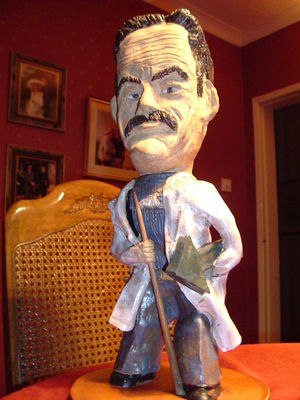
Pass rates soared to the high 90 per cent range, raising eyebrows so much that the RAF sent a team to ensure there was no cheating going on. It concluded that Ray was an exceptional instructor. He was one of only three instructors across the whole RAF at the time who was awarded the top A1 ground instructor grading. When he left, they made a ceramic statue of him in a white coat and with his trademark green arrow.
His exploits included two tours of duty flying the yellow search and rescue Wessex helicopters from RAF Valley in North Wales, conducting sea and mountain rescues, during which he and his crew saved over 100 lives. He also served on the search and rescue training unit, training up the next generation of search and rescue crews.
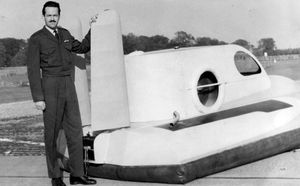
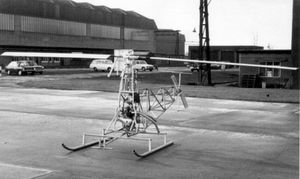
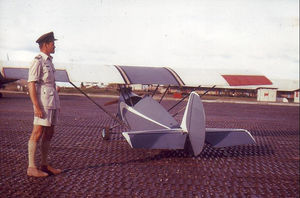
Throughout his career, Ray used his engineering talents to construct many projects. While in Borneo he built the Kuching Flyer, a high winged man-carrying monoplane, while back in the UK he built a large hovercraft and then a simple man-carrying helicopter, building all the components other than the engine himself. He then moved onto radio controlled helicopters and built only the second working model made by an amateur in the UK. He built his sons land yachts and they would career down the runway at Tern Hill at weekends when it was closed to flying.
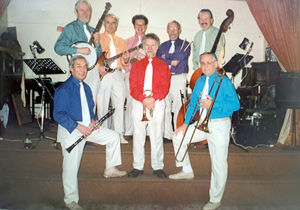
Another string to his bow was as an amateur musician, playing double bass with the Hale Street Stompers, a jazz band which played in Market Drayton at the Stafford Court and Red Lion pubs.
Ray married Sheila, the first girl he ever kissed, in 1955. At the married quarters at Tern Hill she ran the Thrift Shop and organised the Wives Club which welcomed new people to the station. They were together until she died in 2016 after a 61 year marriage.
A private family funeral will be held.