Patriotism 110 years ago: Flags and sacrifice as Clun did its bit for the war effort
These folk in Clun of almost exactly 110 years ago would have been bemused by today's debate about the meaning of patriotism.
As they put up their flags and held their "patriotic jumble sale" on September 8, 1915, things were straightforward. The country was at war and the thing to do was to support the war effort.
This postcard of the occasion comes from the collection of Ray Farlow of Bridgnorth. The event was held under the auspices of the South Shropshire Farmers' Union and raised money towards various war-related funds, including the Red Cross Society.
"The town presented a gala appearance, decorated with flags," reported the contemporary Wellington Journal and Shrewsbury News.
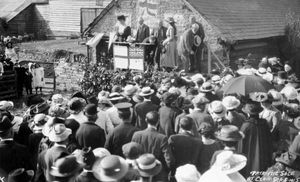
"A coloured streamer spanned The Square, and the entrance to the grounds was converted into an archway of greenery and flags."
The weather was glorious, so that brolly you can see must have been shielding the sun. The venue was Lower House, which is a handsome 17th century house on the High Street, and the various donated lots were laid out in a shed.
"The opening ceremony was graciously performed by the Countess of Powis, accompanied by Lady Hermione Herbert."
They were mother and daughter, and may well be those seen on the platform. Hermione was just a few days short of her 15th birthday.
Mabel Page of Bicton, a hamlet just north of Clun, presented Lady Powis with a bouquet. Mabel would have been about 11 at the time and according to the Wellington Journal's report her brother "was the first upon Clun's roll of honour to fall in the war."
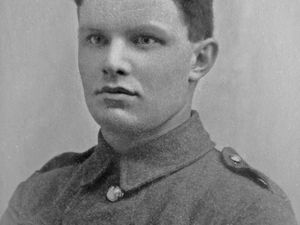
The Clun war memorial has the names of 31 local men who gave their lives in the Great War, including Stanley Page, although he is not recorded as that by the Commonwealth War Graves Commission. Instead it has him as Chaplan Morris, a Private in the 5th Battalion of the King's Shropshire Light Infantry who died on July 15, 1915, at the age of 26.
With there being no conscription at the time, he would have volunteered to do his patriotic duty. Morris was the maiden name of his mother Mary, who had him before her marriage to George Page. In the 1911 census he is with the Page family but his name is given as "Stanley Morris" and he is described as "stepson," and a farm labourer.
The first article to be offered in the patriotic sale was a traycloth which was bought by Lady Powis for 52s. 6d. (that's £2.63 in today's money), and immediately reoffered for sale, which set the tone for the event, with the same being done for a number of lots, in particular a wether lamb given by a Mr Weaver of Rockhill. That was sold 52 times, at about 45 shillings (£2.25 today) each time, and raised in the end over £117, a massive sum for those days.
The postcard was franked at Clun on September 16, 1915, and addressed to Miss L Dudley of Kiddington Hall, Kiddington, in Oxfordshire.
The message was: "Dear Lil, having a quiet time. Hope it will get more exciting such as soldiers coming from the front. But I have some engagements which I must fulfil, tea at Mr (or maybe Mrs, writing uncertain) Scott’s etc. No more now, with love Jen (or maybe Len, as again the handwriting is uncertain)."