'I grow carnivorous plants in my Telford nursery - it's a rewarding hobby for life and you could do it too!'
These bright and exotic-looking plants may be beautiful - but they're hiding a sinister secret.
Humans have nothing to fear, but insects, on the other hand, should be very afraid because despite their innocent appearance, they are actually efficient predators.
Carnivorous plants that can trap and digest their own prey have been a passion for Mike King, who lives in Telford, since he was a young boy.
He started his collection with a venus fly trap, purchased from a flower shop at Waterloo Station when he was 14, and now he runs his own nursery specialising in Sarracenia pitcher plants.
“I’ve been passionate about these plants for 45 years. The idea that a plant could deliberately catch, kill and digest its own food just fascinated me.
“It sounded so strange that plants were turning the tables on the insect world and were eating them rather than the other way around,” says the now 60-year-old.
He began collecting Sarracenia pitcher plants in 1981 and since then his hobby has continued to grow with Mike now tending to around 6,000 plants at his home in Telford.
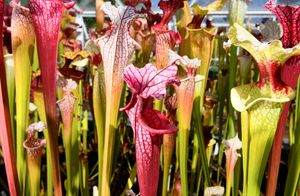
As well as sarracenias, he grows venus flytraps, cobra lilies, sundews and butterworts and since 2002 has been running his nursery, Shropshire Sarracenias. The pitcher plants are mostly found in North America, growing from Florida to British Columbia in sphagnum bogs and wet grassland.
They bear flowers that grow singly on tall leafless stalks and most have long tubular ‘pitchers’.
“There is sticky, sweet nectar on the mouth of the pitcher that attracts the insects. They get lured into the pitcher and because the neck is covered in the nectar, it’s sticky, so they can’t hold on and they fall down the tube and become lunch,” says Mike.
“Because I have so many plants in each of the greenhouses, I will supplement their food with insect-based fish food,” adds Mike.
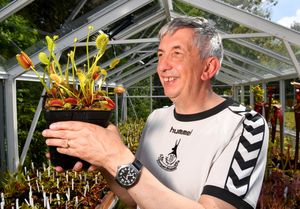
As herbaceous perennials, Sarracenia have a growing season that typically runs from May until October.
“In winter, they are dormant so that’s when I would remove any dead material. If any plant needs dividing, like with any other plant, I would pot it on or split it.
“During the spring, you get a period of rapid growth, just like you see on other plants, and during the summer they maintain the foliage and some of the plants will actually produce another crop of traps.”
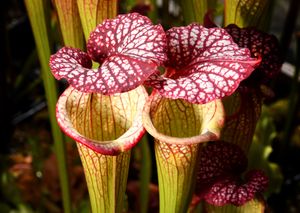
“Cross-breeding allows you to combine characteristics of different plants to create something truly unique. When you get seedlings which are exhibiting characteristics you planned for, or you didn’t plan for, which surprise you – I can’t describe the pleasure that brings,” he says.
Caring for the plants is relatively easy, says Mike, providing they have the correct growing conditions to keep them thriving.
“They need to be sat in rainwater during the growing season and just kept damp. They must not dry out, usually that’s a death sentence for the plants.
“You must not give them tap water because of the chlorine and fluoride and if you live in a hard water area, the calcium is not a big friend of these plants so rainwater, or distilled water or even reverse osmosis water is best if you can’t get rainwater. They’re easy to grow, if you remember the simple rules: they like sun, not shade, and like rainwater, not tap water, and basically they need to be kept tidy.
“You can grow them in a variety of places outside, like a greenhouse, or you can grow them on a sunny windowsill, providing it’s not too hot for them in winter. The best way is to start small with a small gravel tray full of rainwater in a sunny spot and you get rewarded as you begin to fall in love with your plants and the collecting bug kicks in,” adds Mike.
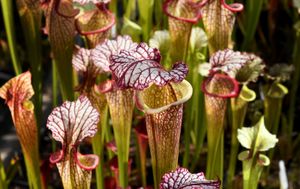
In 2003, Mike was awarded National Plant Collection holder status for his sarracenias by the National Council for the Conservation of Plants and Gardens, which is now known as Plant Heritage.
A National Plant Collection is a registered and documented collection of a group of plants that can be linked botanically by plant group, or perhaps have a shared history or geography.
The collections are made available for people to view, either by appointment or on special open days, and every year Mike welcomes visitors to his greenhouses.
“What I love about these plants is no longer about the carnivory - that went when I was a kid. It’s the colours, the shapes and the fact they so easily interbreed,” says Mike.
“You can use your imagination for what colour you would like and just by transferring pollen from one flower to another when they’re in bloom, you get something brand new.
“For me, that keeps the enthusiasm going after all these years – it’s a hobby for life.”
For more information, see https://www.carnivorousplants.uk.com/.