BGS tour visits Shropshire
By Keith Stevens
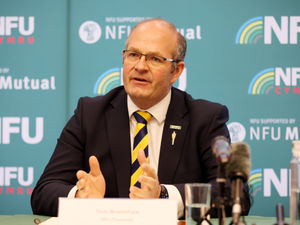
Based at the Harper Adams University campus, the four day British Grassland Society Summer Meeting was very successfully organised by the Shropshire Grassland Society under the able and amiable chairmanship of Harper Adams lecturer Jim Huntington. There was an attendance of 175 delegates from Cornwall and Cumbria to Michigan, USA.
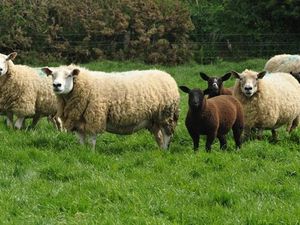
The theme was how grass can be used to boost profit, and James and Rob Evans of Walcot Farm, Lydbury North, and Partridge Farm near Bishops Castle, fully demonstrated this with their 300 Stabiliser suckler cows. They moved into Stabilisers 10 years ago when they realised their market price topping finished continental cross breds were giving poor financial returns and Holstein cross suckler cows were too milky.
The Spring calving half of the herd, 180 cows, grazing at Partridge Farm calve outside. They calve over nine weeks from April 1and the calves are small, only 37-40kg after a short 279/280-day gestation period, but they are up and sucking in 15 minutes says James and they don’t worry if the cows seem over- fit at a 3.5 to 4.5 condition score. All fitted with Pin Point heat detection collars, about 100 are served with Cogent sexed semen to increase herd heifer numbers and because their heifers are being sold though the Stabiliser propagator breeding scheme at £1400 as 400kg bulling heifers. The bulls that are sold for breeding at £3000 to £5000 depending on their EBV’s, are again all sold under the scheme and increasingly are sold unseen.
The Stabiliser cows viewed by the Summer Tour were the 140 autumn calving cows at Walcot Farm, a 760 acre unit with 200 acres of parkland permanent pasture bought by the family as sitting tenants in 1953 from the Powis Estate. Grazing parkland on the side of a lake the cattle were fenced off to avoid catching BVD from the water.
Changes to Higher Level Stewardship which limit the grazing and cutting dates, have seen the Evans family drop out of the scheme this year. Next year they will further concentrate on cell grazing, splitting their grazing land into paddocks. Many beef farmers James Evans says could double their grazing potential by splitting up their fields. One serious limiting factor though is where and how many water troughs you have in a field. They have overcome this with a New Zealand invention of a small water bowl fitted with a 15-inch spike to go into the ground, attached to the end of a long movable plastic water pipe. Up to 60 cattle will satisfactorily drink from this water bowl allowing him to divide a 25 acre grazing field into 11 paddocks, which he does not fertilise after July 1.
Bull calves of the 140 September calvers are creep-fed from November on a barley based TMR ration to push them on as at six months old all the Autumn calvers are out grazing grass. Those bulls sold for breeding (10 per cent) are scrotal measured, as it has been found that bulls with scrotal measurements of less than 34cm produce offspring with lower fertility. The males sold for meat at 12 to 13 months of age with carcase weights of 360/380kg with a 57 per cent killing out percentage are giving carcase gains of 1kg, a day.
There is too much emphasis on big back ends, says James, not only does it make calving more difficult f, but the consumer beef interest is increasingly on quality loin steaks.
The 800 acres of arable on this farm and the contract-farmed 1300 acre Partridge Farm are under the direction of brother Rob. He benefits from poultry manure from their 32,000 bird laying unit at Walcot Farm, where eggs are sold for flu vaccine production, and from yard muck from the cattle that are mostly housed after the beginning of November.
Arable land Walcot Farm rises to 750 ft and has a rotation of spring barley, oats, winter wheat, winter barley, stubble turnips, spring barley, then winter oats. Some flat land is rented out for potatoes with a rotation based on two wheats, barley, then potatoes. Four-tonne wheat yields are obtained on the limestone based medium loam soil, with oat yields of three tonnes and barley yields touching three tonnes. The 900 Lleyn ewes are winter grazed January to March on the stubble turnips.