Is biofuel the future for farmers?
It is interesting to think that the closure of Allscott's sugar beet factory could actually have been one of the best things to happen to Shropshire's agriculture industry, writes Nathan Rous.
 It is interesting to think that the closure of Allscott's sugar beet factory could actually have been one of the best things to happen to Shropshire's agriculture industry.
Despite the panic and hand-wringing that accompanied the closure, farmers who were forced into growing grain or oil seed rape have seen those prices double.
Sugar prices, on the other hand, have plunged. Indeed, farmers in the east of England who rejoiced when their factories stayed open are now eyeing Shropshire with a deal of envy.
But with grain prices so high, will Britain ever focus on the biofuel market? And, if it does, what effect will that have on our ability to feed ourselves?
Andrew Richards, senior policy advisor at the NFU's regional headquarters in Telford, is convinced that biofuel production has been put on the back burner.
"It is fair to say that a lot of farmers in Shropshire are glad to be out of sugar beet production," he said. "Of course, in 2006 the Allscott situation developed rather unexpectedly.
"Yet while farmers' hands were forced they at least appear to be better off as a result.
"The price of grain and oil seed rape has gone to levels not seen for an awful long time while sugar beet has gone the other way.
"It would take a pretty brave individual to take that out and contract into the biofuel market at half the price. With the price of oil at nearly 100 dollars a barrel the incentive to produce biofuels is still there. But I'm afraid I think the financial backers have taken a step back. Once people are running cars which burn biofuels or get them converted the producers will take a keener interest."
With both drought and floods affecting harvests across the globe, coupled with a shift to biofuel production, there are fears that Britain could soon struggle to grow its own food.
 Shropshire agricultural consultant Bryce Rham said with high numbers of sheep, beef and pig farmers struggling to cope with rock bottom prices and high feed costs he was genuinely concerned for Britain's ability to feed itself.
"I am quite fearful for us as a country," he said. "This is not an industry which you can pick up and put down. Once it's lost, it's lost.
"I have guys who are spending £100,000 a year and more on feed for 2008 than they were in 2006. That is a staggering increase.
"These people are working 100 hours a week and should rightly be earning good money but instead they are wondering whether it is worth it.
"Consumers, supermarket bosses and the Government needs to give them their support now, before it's too late."
Of course, Prime Minister Gordon Brown will be desperate to avoid price increases in the shops because of the damaging effect it could have on inflation.
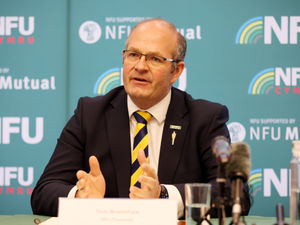
However, NFU president Peter Kendall, who visited Shropshire this month, believed price rises were unavoidable.
"All things being equal, biofuels will put up the price of cereals and oil seeds and therefore have a modest impact on food prices," he said.
"But we need to keep this in perspective. Farmers' prices have been falling for more than a century in real terms so at most this would amount to an adjustment.
"Over the past century retail prices have risen four times more than the price of food as it leaves the farm.
"If the price of wheat had increased with inflation over the past century then wheat would be worth £600 a tonne rather than just over £100."
There are many who would prefer the Brazilians to use their entire acreage to produce biofuels rather than leaking its dubious beef onto the British market - beef that fails all the standards that British farmers have to adhere to but still gets sold on our shelves.
But with so much land being needed for biofuel production, will traditional farms be squeezed out of the market? Not so, Mr Kendall said.
"The concern that biofuels are bad for the livestock sector is a criticism that is sometimes heard from within the farming industry.
"However, biofuels provide a new market for cereals and oil seeds which helps to maintain arable production capacity in the UK and the ability to respond effectively and efficiently to any future increased demand in both food and fuel markets.
"Let's not forget that the co-products of biofuels - distilled dried grains from bioethanol and oil seed rape meal from biodiesel - make excellent feeds for livestock."
Despite the move to be green, the construction of bio-energy plants has certainly raised eyebrows and protests.
In Bishop's Castle, a move to create a biomass plant on the edge of the town has created a storm of controversy.
But with oil seed rape reaching £275 per tonne for commercial use and less than £200 per tonne for industrial contracts, the jury is still out on when the biofuel revolution will really take hold.
Facts about biofuel production and use:
Biofuels are any kind of fuel made from living things, or from the waste they produce.
The list includes wood, wood chippings, straw, methane from animals' excrement, ethanol, diesel or other liquid fuels made from processing plant material or waste oil.
In recent years, the term "biofuel" has come to mean the last category - ethanol and diesel, made from crops including corn, sugarcane and rapeseed.
Production of ethanol doubled globally between 2000 and 2005, with biodiesel output quadrupling.
Brazil leads the world in production and use, making about 16 billion litres per year of ethanol from its sugarcane industry.
Sixty per cent of new cars can run on a fuel mix, which includes 85 per cent ethanol.
The European Union has a target for 2010 that 5.75 per cent of transport fuels should come from biological sources, but the target is unlikely to be met.
By Nathan Rous