Farmers hope for brighter 2008
Given that at one stage three dairy farmers in Britain were quitting the industry every week, 2007 could have wiped out the industry.
 Given that at one stage three dairy farmers in Britain were quitting the industry every week, 2007 could have wiped out the industry.
But although there have been a number of high-profile casualties in Shropshire, many farmers have bravely stayed the course for what has been the roughest of all rollercoaster rides.
From the depths of receiving just 17p per litre at the start of the year, global demand and lack of supply means many farmers are now getting upwards of 25p.
Perhaps it is still a little early to be uncorking the Champagne but, there are definitely signs of a revival.
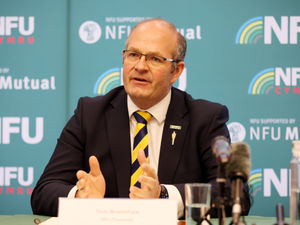
Andrew Richards, senior policy adviser at the NFU in Telford, said it has not come a moment too soon.
"Dairy prices have gone crazy and, boy, did they need to," he said. "There are a number of reasons for that, including expanding prosperity across the globe and supermarkets at long last realising that if they do not get themselves together they will not have a home supply."
Mr Richards said he had feared in the summer that Britain's dairy industry had suffered irreparable damage. "To be honest with you I was very, very depressed by the whole situation.
"Around the time of Shropshire's Great Milk Debate in April we thought we were facing meltdown in the dairy sector.
"We have had nearly 10 years in the doldrums where prices have been desperately low and reinvestment non-existent. We really need a period of stability because we seriously cannot afford another 2007."
Although the outlook is certainly brighter at the end of 2007 than it was at the beginning of it, farmers are still quitting the dairy industry in their droves.
Mr Richards said: "We have lost a lot of dairy farmers. They have been haemhorraging at an enormous rate and I suspect that will continue because there is still the threat of TB, the increase in feed costs and the fact that good staff, if you can afford them, are at a real premium."
Paul Dutton, a traditional dairy farmer from Calverhall, near Whitchurch, said: "The year started on a bad footing because the poor, mature silage made in June the year before did not produce as much milk as I expected resulting in us needing to buy extra feed. With the milk price so low the resulting margin was poor or non-existent.
"The milk price was the main talking point all through winter and spring. Couldn't they see the numbers of dairy farmers leaving the industry? But who can blame families giving up. Since we held the Great Milk Debate at the end of April the price paid for milk on the farm has climbed each week to a level not seen for 10 years. We are looking at 27p per litre for the new year. At last the borrowings that many dairy farmers have had to make may start to reduce.
"But along with the improved milk price comes a hike in feed prices, which reflects the arable farmers' financial upturn for the same reasons of world shortage, increased demand and the effect of bio-fuel.
"My compound feed costs have increased £20 per tonne and brewers' grains (spent barley after beer is brewed) up £12."
And then the rains came. "From mid-June to the end of July the incessant rain made life extremely difficult," said Mr Dutton.
"On August 4, foot and mouth disease was confirmed in Surrey. And then bluetongue. I do not think anyone fully understood the consequences of both the effect on livestock and the movement restriction imposed."
Organic dairy farmers have fared better than most. Tim Downes, of Shrewsbury, will celebrate his 10th anniversary as an organic dairy farmer next year.
He said: "The market has grown for organic dairy products by 25 per cent in the past three years with well over 2.5 million people regularly purchasing organic milk."
"The volume of organic milk produced has struggled to keep pace with demand."
He said there was no longer a prohibitive price barrier either. "Consumers are now able to enjoy a switch to organic milk for less than £1 per week."
Facts and figures:
The total turnover of the British dairy industry is £6 billion, around 10 per cent of total food and manufacturing output.
More than 50,000 farmers and farm workers are employed on dairy farms in the UK. A further 34,000 people work in the milk industry driving tankers, pasteurising milk and packing and distributing dairy products.
Dairy cattle grazing in fields are an important feature of the British countryside, one of our greatest national treasures.
Grazing animals are important to the vegetation structure of pasture land through selective grazing, trampling and manure
Top sources of calcium are milk, yoghurt and cheese. About 72 per cent of calcium in the British food supply is from dairy foods.
According to Government statistics, children aged nine to 18 need three servings of dairy products daily. Only 30 per cent of teenage boys and 12 per cent of teenage girls meet this recommendation.
By Rural Affairs Editor Nathan Rous