Shropshire students in out of this world planet discovery
They were only doing their work experience but students from Shropshire may have just have found new planets in a galaxy far away.
The two new exo-planets may have been discovered by students taking part in work alongside boffins at a Midlands university.
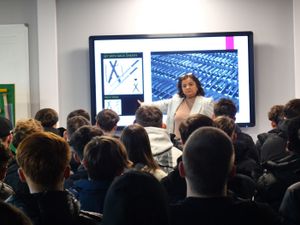
Students aged from 15 to 17 from schools and colleges in Shropshire, Staffordshire and Cheshire came together for a week in the Lennard-Jones building at Keele University, near Newcastle-under-Lyme.
They worked on a research project aiming to discover exo-planets, planets that orbit other stars, and to characterise eclipsing stellar binary systems.
After painstakingly searching through more than 70 days' worth of data on distant galaxies, the pupils managed to find a repeated pattern of light being blocked by a planet about 0.2 per cent of the size of the star itself.
The students were excited by the discovery.
Professor Rob Jeffries, of the university, oversaw the discovery, which will be verified over the coming year.
He said: "They were all pretty interested when they arrived. We've seen over the week that they've got more fired up as they've started to understand more about what they're doing.
"The project entailed the students rapidly assimilating a great deal of new knowledge about stellar variability and astrophysical measurements.
"They also had to practise and improve many transferable skills: team building, time management, information retrieval, communication and presentation, computing and problem solving.
"It could be the best part of a year before we know if these candidate planets are genuine. We work in a large international collaboration.
"The planets are in the constellation Virgo, that means they're not particularly well placed to verify until spring. WBut we now have a network – we have all the students' contact details, and if there is any news, they will all be informed, and possibly even credited if it leads to a publication."The potential planets orbit a star, much like the Sun, that is about 800 light years away. The star was previously an anonymous object, about 100 times fainter than visible with the naked eye.
Their find was part of Project Tatooine, looking for rare planets that orbit around double stars. The project is named for a similar planet in the Star Wars franchise.