Medals of RAF war hero who was shot down and taken prisoner set to be auctioned at Shrewsbury sale
A Distinguished Flying Medal group awarded to a flight engineer in the Royal Air Force’s Pathfinder Force during the Second World War is to be sold at auction in Shrewsbury later this year.
The group, together with a ‘Caterpillar Club’ badge awarded to Flight Engineer James Keith Spedding, 35 Squadron, is valued at up to £1,500 and is included in Halls Fine Art’s militaria auction on August 27.
Entries for the auction close on August 1.
The RAF's Pathfinder Force was an elite group of target-marking squadrons in Bomber Command during the Second World War. They marked targets with flares, enabling the main bomber force to achieve more accurate bombing.
The Pathfinder Force was crucial for improving the efficiency and accuracy of Allied air campaigns over mainland Europe.
Flight Sergeant Spedding, who was born in West Derby, Lancashire, in 1922 and died in Bristol in 2002, completed 47 operational sorties from March 15, 1944, before being shot down over Germany and taken prisoner on February 21, 1945.
His medal group, which has been consigned by his family, includes the Distinguished Flying Medal, 1939-‘45 Star, Air Crew Europe Star with France and Germany Clasp, 1939-45 War Medal and Defence Medal.
Accompanying the medals is a yellow metal Caterpillar Club badge, engraved with Spedding’s name on the reverse, featuring enamel eyes and an original certificate.
The badge was awarded to RAF and Alied personnel who had bailed out of a disabled aircraft successfully, wearing a parachute made by the Irvin Air Shute Company.
Also included are two Pathfinder badges, a piece of shrapnel from a chest wound sustained under enemy fire and three ties, including Pathfinder Force.
The group is further complemented by an archive of documentation in an album, including a portrait of Flt Sgt Spedding and fellow crew members, alongside two other wartime photographs.
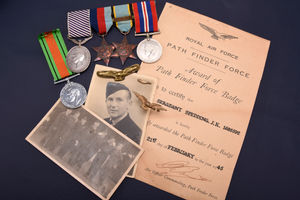
There is also a Buckingham Palace slip and an official letter accompanying the award of the DFM, a Pathfinder Force Badge certificate for Flt Sgt Spedding, dated February 21, 1945, a registration form for recovered Allied Prisoners of War, recording his internment at Stalag Luft III (A) and Stalag VII-A.
The album also contains a poignant letter to Mrs Spedding reporting that her husband was missing in action, which referred to a “particularly good” record of service and describing him as being “absolutely fearless on operations”.
The letter added: “It will not be easy to replace him."
In addition, there are two Feldpostkarte with daily entries detailing his capture and experiences from February 21 to April 10, 1945 and post-war paperwork and photographs of reunions and related newspaper clippings.
Caroline Dennard, Halls Fine Art’s militaria specialist, said: “This is a wonderful medal group awarded to a member of one of the highly sought-after and daring Second World War Pathfinder Squadrons.
“Flight Engineer Spedding completed a remarkable 47 operational sorties before being shot down and the inclusion of the Caterpillar Club badge and related ephemera makes this a worthy addition to any serious RAF collection.”
Flt Sgt Spedding enlisted on March 18, 1942 and joined C Flight 35 Squadron, Graveley in February 1944 as part of Pilot Officer J. J. Osmond’s crew and later moved to B Flight. Flt Sgt Spedding was with 466 Squadron before being posted to 35 Squadron.
On February 21, 1945, he and his crewmates were in one of six Lancasters shot down near Duisburg resulting in the loss of Flight Officer Bert William Golden who is buried in the Reichswald Forest war cemetery.
The surviving crew became prisoners of war.
Spedding spent time in Stalag III (A) at Luckenwalde and Stalag VII-A at Moosburg, Bavaria which was liberated by Allied forces on April 28. He returned to the UK on May 11.