Shropshire war heroes awarded Arctic Star medals
It has taken more than 70 years but finally a group of brave Shropshire war heroes have finally been honoured for their part in fighting to keep open supply routes in the icy waters of the Arctic Circle.
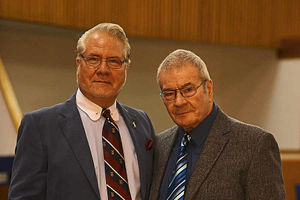
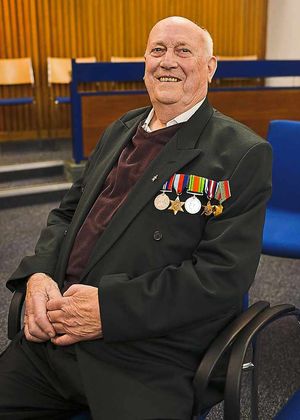
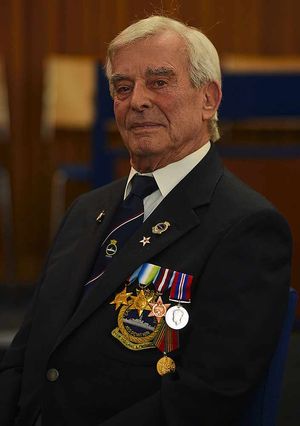
The men braved sub-zero temperatures and perilous seas to slow Germany's advances on the Eastern Front in 1942.
More than 3,000 Royal Navy and merchant seaman died in the convoys that battled to supply allied Soviet ports.
Their efforts went unrewarded in the UK until the Government unveiled the Arctic Star medal in 2013 to honour the estimated 200 surviving veterans.
Now, more than 70 years after completing what Winston Churchill described as the "worst journey in the world", more than 30 Shropshire men have been handed their medals in a ceremony held at the Shirehall in Shrewsbury last night.
One of the veterans who was there to collect his medal was 90-year-old war veteran Roger Rowley, of Trench, Telford.
Mr Rowley joined the Royal Navy in 1941 and was originally based in Devonport, Plymouth.
He said: "I decided to join the navy as a volunteer as I knew the alternative would mean I would have to go down the mines which I did not want to do. I went on my first trip in 1947 and was a radar operator. I had to sit in a cabin and watch the screen and use technology that was very new to everyone.
"I then went on an Atlantic convoy and saw a lot of ships sunk. I was at sea for about six weeks and used to work for four hours and then have four hours off to sleep.
"I went on another trip to Murmansk which was very cold with rough seas. On the way back we managed to sink a U-boat. I then went to Archangel and we sunk another U-boat on the way back.
"During D-day I was on a ship which was patrolling the English Channel. It was a very scary time but it all came naturally to me.
"It is something that will stay with me for the rest of my life.
"I am glad we are finally getting the medal. It has taken a long time."
Around 200 soldiers will march through Shropshire's county town with swords drawn, standards flying and drums beating at 2pm after being granted and exercising the Freedom of the Borough by Shrewsbury Town Council.
The parade will see the regiment also attend a church service at St Chad's Church at 1pm before forming up for an inspection by the mayor, Councillor Beverley Baker.
After the church service, the troops will march via Smithfield Road, Castle Gates, St Mary's Street, High Street, Barker Street, Welsh Bridge and Frankwell car park to the Guildhall, to be received by the mayor.
The parade will be headed up by the Army's Jackal 1, a light armoured vehicle, and will be followed by the Band of the Royal Armoured Corps, troops from the Waterloo Division, the Quarter Guard and Standard Party, the Gazzalla Division, the Lucknow Division and Jackal 2.
The regiment, which is based in Sennelager, Germany but recruits from Shropshire, Wales and other border counties, has recently returned from a six-month operational tour of Afghanistan.
For these veterans, who died before they were honoured, their families were invited to accept the awards on behalf of them.
Amongst the families were brothers Keith Allen, 68 and Tony, 76 of Shrewsbury who proudly collected their father Thomas Allen's star. They attended on behalf of their mother Annie who is 101 and lives at Holy Cross Care Home in Abbey Foregate.
Members of the Russian embassy presented the medals at the ceremony attended by a number of civic dignitaries.
Keith Allen said: "My father joined the Navy at 16 and progressed through the ranks until 1941 and 42 he was on HMS Seagull on the Arctic Convoys.
"He did 10 trips – five out to Russia and five back.
"He went through his career until eventually he was demobbed in 1949. He met my mother and they had my older brother Tony and then me. Then three months after I was born my father was posted to Malta for three years.
"I was too young to know but my brother who actually experienced it said it was just a way of life.
"Our mother used to get a telegram whenever he was docked in Liverpool and they would go and see him.
"My brother told me that when my father returned home I hid behind my mother's pinny because I had never met him. I didn't know who he was.
"He went to work on the tugs that bring in huge liners until 1961 they found out he had cancer and that took its toll on him. He fell down in the street and died. I was 14."
Speaking about the experience of collecting their father's medals, Keith said: "I've been collecting my father's war medals and putting them in a little box for my mother.
"I get very emotional and I am very proud of my father."
The Arctic convoys of World War Two sailed from Britain, Iceland, and North America to northern ports in the Soviet Union – primarily Archangel and Murmansk. There were 78 convoys between August 1941 and May 1945.
Also at the ceremony was Fred Gorton, 88, of Market Drayton, who joined the Royal Navy in 1943. He said: "
It was a very tough environment. This is a long time coming but I am glad we are getting it."