New treatment offers hope to childless couples in Shropshire
With hundreds of thousands of test tube babies living in the world, In Vitro Fertilization, or IVF, has become much more common these days.
Yet the process is never routine, nor is a successful pregnancy guaranteed.
The birth of a test tube baby used to always hit the headlines, but now, 36 years after the world's first, it has become so common that it isn't always publicised.
IVF hasn't worked for everyone, but over the last few years a pioneering fertility treatment has been developed which has been making dreams come true for more parents-to-be.
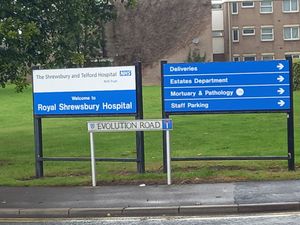
And people living in Shropshire and Mid Wales will be pleased to know that the Shrewsbury and Telford Hospital NHS Trust has begun using the technique for women undergoing IVF treatment who are unable to get pregnant.
The trust began using the procedure about six months ago and so far five patients have become pregnant after having the treatment.
Andrew Sizer, a consultant in reproductive medicine and surgery at the trust, said: "In IVF there are a number of patients who may have several treatments and statistically should get pregnant, but they don't.
"If they have three transfers of good quality embryos and they are still not getting pregnant, that is referred to as recurrent implantation failure.
"That is when we consider using the endometrial scratch technique, which is a very quick procedure.
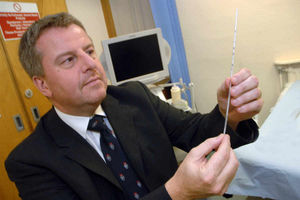
"It involves the lining of the womb being gently 'scratched' using a thin catheter which is passed through the cervix.
"The repair process releases growth factors, hormones and chemicals. The new lining which grows after the procedure is thought to be more receptive to an implanting embryo and so increases the chances of pregnancy."
The technique was developed because doctors have been trying to find out who might have a problem with their uterine lining that is stopping embryos from implanting at IVF.
The simple 15-minute procedure costing around £200 has been shown to nearly double the success rate of IVF treatment, a study last year disclosed.
The research, led by British scientists, also showed for the first time that the technique increased the number of babies born as a result.
The procedure is available for eligible patients, although at present it is restricted to patients who have recurrent implantation failure.
Mr Sizer added: "We follow medical literature and emerging techniques. I also hold a miscarriage clinic. We are always looking for things to help patients.
"This is a simple inexpensive technique that appears to be promising in helping a specific group of patients with problems of implantation to achieve a pregnancy.
"It's not known to be harmful and there is clear medical evidence to support its use.
"Everyone who has been through it say they didn't think it was as bad as they thought it would be.
"Unfortunately it is not going to help everybody, but for a specific group it is promising for improving their outcome for the future."
One of the first patients to fall pregnant from the procedure used by the hospital trust, who did not wish to be named, had it done on Boxing Day and is due to give birth on October 26.
The 32-year-old from Oswestry, who is expecting her first child, said she had been trying to conceive for about five years.
She said: "The procedure was something I was slightly aware of as I had already been looking at it on the internet.
"We had an appointment with Mr Sizer to discuss it. We then went away to have a chat and felt it was worth having a go.
"They have to time the procedure so many weeks before the transfer and so many weeks after the menstrual cycle. It was a coincidence that it was Boxing Day.
"It was mid-February when we found out I was pregnant. We were absolutely thrilled and there was a sense of relief and shock."
She added: "We have had a few near misses in the past. We have been visiting a fertility clinic for about two-and-a-half years. We have been trying to conceive for about five years.
"We remain quietly excited and cautious until they arrive.
"I can't remember how much the procedure cost but I remember us thinking it wasn't that bad."
Mr Sizer, Dr Massoud Tarfaya, an associate specialist and Bernard Bentick, a consultant in reproductive medicine and surgery, all carry out the procedure at the trust.
Last month IVF pioneer Lord Winston warned that a growing market for fertility treatments could "threaten our humanity", including if the rich were able to pay for so-called 'designer babies'.
The fertility expert who developed key advancements in IVF treatment told fellow academics at a conference "we have been carried away" by breakthroughs in reproduction.
But Dr Allan Pacey, chairman of the British Fertility Society, said parents are not interested in enhancing their babies' genes.
"The law prohibits it, even if it was technically possible," he said.
"Most infertile couples are desperate for a baby, rather than a specific type of baby, and I don't see that changing."
For more information about endometrial scratching and other IVF treatment visit www.shropshireivf.nhs.uk