The night a bomber landed on Shropshire
Like many war veterans, Luftwaffe airman Alfred Achstaller didn't really talk much about that night in November 1940 at the height of the Blitz when his Heinkel bomber came crashing down in rural Shropshire, claiming the lives of two of his colleagues.
But his son Manfred made a record of a conversation with his father in which he described the events just before the decision was made to bale out of the stricken aircraft, and what the parachute jump was like.
Alfred died in 1988. In recent years, Manfred has tried to find out more about his wartime experiences – and it is a trail which has led from Germany back to Shropshire, and the Shropshire people for whom the Achstaller family feel such gratitude for the humane way Alfred was treated.
The crash was researched decades ago by John Durnell, a lifelong aviation enthusiast, who lived then in Church Aston, near Newport – he lives now at Lake Vyrnwy.
John's son Adrian, of Pontfadog, said: "In the 1970s my father spoke to the policeman who arrested the two survivors, members of the Home Guard who were there, a young lady who was cycling to work and was confronted by a German airman calling for help – she rode off at some speed – and also a nurse at Cross Houses Hospital who cared for the two survivors. The pilot was there for six weeks.
"Earlier this year we were contacted by Manfred Achstaller, son of Alfred, who was the observer of the aircraft.
"We were amazed how Manfred managed to find my father. The Achstaller family are eternally grateful to the people living around Much Wenlock who treated Alfred in such a decent and humane way despite the horrors of war. They could have reacted quite differently. It is hoped that a small booklet can be produced locally to record this for future generations, and any information that people may still have – no matter how small – would be of great interest."
So what happened on that fateful night of November 15/16, 1940?
Heinkel He III, serial code A1+LN, was on its second operational raid, taking off from Lille Vendeville in northern France, the main target being an aircraft works in Coventry, and they were then to bomb Birmingham.
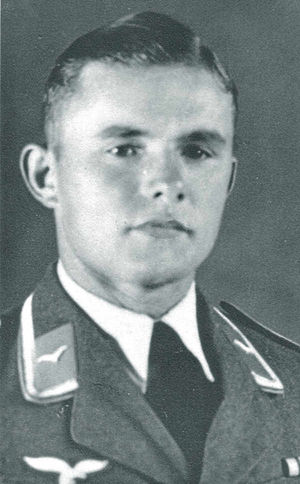
The crew was: pilot and captain, Lt Karl Svata, aged 34; navigator, bomb aimer and gunner, Fw. Alfred Achstaller, aged 26, who came from the tiny village of Mambach im Wiesental in the Black Forest – son Manfred lives there still; wireless operator and gunner, Uffz. Josef Mutzl, aged 23; and flight engineer and gunner, Fw. Heinrich Engelken, aged 26.
Unable to find their primary target due to bad weather and smoke from the previous night's Coventry raid, they carried on to Birmingham and dropped their bombs.
The aircraft then started to climb to 19,000ft for the return journey, at that time flying over south-eastern Shropshire. However the wings started to ice up badly. The aircraft went in to a steep dive, and began to break up.
Alfred was to recall: "We were climbing when suddenly the aircraft had a problem. I shouted to Karl: Karl . . . out . . . get out . . ., everybody get out . . . I jumped out without knowing what was up and what was down. It was pitch dark. I pulled the ripcord on my parachute and it deployed, but I didn't know when I would touch the ground. I landed on my back on a fence post, hence the big scar on my right shoulder blade."
Pilot Karl Svata broke his leg on landing. The other two crew members were killed.
Wreckage came down in a field at Derrington, between Monkhopton and Ditton Priors, and at Netchwood, about a mile away.
Svata and Achstaller landed in fields close to Spoonhill Wood, a relatively remote area close to Callaughton. Injured, cold, and shocked, it was some hours before they were discovered.
They were taken by ambulance to Cross Houses Hospital. Later that day, Alfred was interrogated, and found "a reasonable type who makes a good impression and has no pronounced political views."
At the end of January 1941 he was moved to Canada, finally being repatriated to Germany in the spring of 1947.
Speaking about the idea of a booklet to tell the story, Manfred says it would be "a small sign for the young generation living around Derrington about the humanity exhibited by their grandparents and other relatives."
Anyone with memories of those dramatic events over 70 years ago can contact Adrian at adrian107@btinternet.com or 01691 718656.