Not enough depth in this fight for survival
Apollo 13: The True Story (Channel 5) - TV review by by Carl Jones - It's April 1970, and the boffins at mission control were preparing to begin the countdown for their latest space mission.
It's April 1970, and the boffins at mission control were preparing to begin the countdown for their latest space mission.
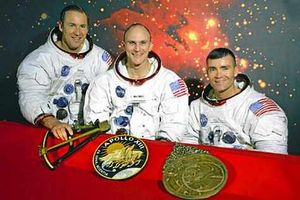
On the launchpad was the fateful Apollo 13 – destined never to touch down on the surface of the moon.
Given the huge dangers involved in blasting man into orbit, you'd have thought some superstitious brand management consultant at the Kennedy Space Center might have raised the herd of elephants in the room.
"Are we quite sure about the name of the craft, fellas . . ? Isn't the number 13 supposed to be unlucky . . ? And aren't we making matters worse by taking off at 13.13pm . . ?"
Perhaps, though, after two successful and highly publicised moon landings in less than a year, the Americans had become too cock-sure to consider such signals – even when another bad omen emerged and original crewman, Ken Mattingley, had to be replaced after being taken ill just days before take-off.
Yet the guys at Houston, as we all know, soon had a problem when an exploding oxygen tank put paid to the USA's third mission to the moon, leaving three astronauts fighting for survival 200,000 miles above the earth.
It has become almost impossible to mention the words Apollo 13 without picturing Tom Hanks as the crew's stoical captain, Jim Lovell; such is the power of Hollywood to turn an embarrassing stain on Nasa's reputation into an Oscar-winning blockbuster.
But just how much of the 1995 tale was based on fact, and how much was fiction? That's what this programme set out to answer through a combination of interviews with the main players, experiments and reconstructions.
Unsurprisingly, the conclusion of this hour-long special was that movie director Ron Howard took several creative liberties with what was already a remarkable story of human survival, to crank up the big-screen tension. Tell us something we didn't know . . .
This was a frustrating programme, despite its many fascinating ingredients; Howard's thoughts on how he approached making the movies, interviews with the main players both in the air and on the ground, and a couple of experiments which sought to recreate the type of conditions the astronauts would have been facing.
But it felt like a hastily assembled highlights reel glossing over all the key points of an in-depth series which would have been far more interesting.
By the time three commercial breaks had been thrown in, there was barely time for the rather nerdy narrator, Nigel Reed, to scratch beneath the surface.
One of the few genuinely touching moments came from Jim Lovell and Fred Haise as they reflected on the hours their craft floated helplessly around the surface of the moon, knowing by then they would never realise their ambition of walking on its surface.
Four decades on, their regret is clearly still raw.
Aside from that, though, there was precious little emotion on display – no wonder Ron Howard had to sex up the script.
Perhaps surprisingly, the real-life heroes interviewed did not appear the least bit concerned with the way Howard had veered from the truth.
That's because they all came across as unflappable folk, whose calm, calculated heroism and creativity saved the lives of three astronauts, and the blushes of a nation.
And what about that the famous phrase "Houston, we have a problem"?
Turns out that no-one ever actually uttered it that way.